Ihre Suchergebnisse (52 gefunden)

www.musicweb-international.com

Rezension www.musicweb-international.com Monday January 29th | Stephen Greenbank | 29. Januar 2018 I can understand why many find Reger's music unforgiving and daunting. It took...

I can understand why many find Reger's music unforgiving and daunting. It took me a while to crack the hard shell of the nut. Once I did, after much perseverance, I discovered the wealth of treasures that lie within. I am pleased to say that the music featured on this disc is some of the least forbidding in his output. A large part of Reger's compositional oeuvre consists of chamber music, and these two String Trios and Piano Quartet are certainly more approachable than the String Quartets.

“It is absolutely clear to me that what our present age lacks is a Mozart” declared Reger in June 1904. The result was the String Trio No. 1 in A minor, Op. 77b. It was premiered in November of that same year to great critical acclaim. It sounds quite extrovert at times, almost certainly in an attempt to capture some of that Mozartian lightness. After a solemn introduction, the opening movement suddenly springs to life, the energetic thrust alternates with contrasting lyrical warmth. A tender Larghetto follows, reflective in disposition. The good-humoured Scherzo sounds quite neoclassical in style. Quoting a theme from Mozart's Abduction from the Seraglio, the finale cannot fail to raise a smile.

I, personally, find the String Trio in D minor, Op. 141b the more attractive of the two; maybe this is the reason why it is positioned first on the CD. A late work, it was completed in 1915, a year before Reger’s untimely death. It is a reworking of a Flute Serenade, Op. 141a, and is structured in three movements. Despite the glow of the opening movement, there is a pervading sadness and sense of longing. This is followed by a theme and variations, elegant and skilfully etched. The Vivace, which ends the work, is sun-soaked, with a playful abandon. The Trio proved popular with public and critics alike after the first performance, and it is hardly surprising.

The Trio Lirico join forces with pianist Detlev Eisinger for an impassioned reading of the Piano Quartet No. 2 in A minor, Op. 133. The work was begun in 1914 and premiered at the Leipzig Gewandhaus in February 1915. It was published a year later. At the time, the critics praised its “glorious sororities” and its “vocal, vivid and catchy” melodies. For me, there are powerful echoes of Brahms in the music. Reger's often dense, syrupy textures and virtuosic piano writing are a notable feature of the intensely passionate opening movement. A frolicsome Vivace follows, offering some light relief. A noble, ardently-etched Largo precedes a spirited finale.

The Trio Lirico was formed in 2014, and this is their debut CD. Recorded last year, it marks the centenary of the composer's death on 1916. These are stunning performances, with precision ensemble. The Trio are utterly committed to the music and their interpretations are thoroughly convincing. Detlev Eisinger I would equally praise for the passion, energy and refinement he brings to the Piano Quartet. Audite's plush sound is another asset. For the uninitiated, especially, this constitutes a highly recommended Reger chamber music primer.

Fanfare

Rezension Fanfare July / August 2018 | Gavin Dixon | 1. Juli 2018 These three works all bring out Reger’s Mozartian sensibilities. The textures...

These three works all bring out Reger’s Mozartian sensibilities. The textures are clear and the movements are well structured and well proportioned. Yet there is little sense of Neoclassical restraint here: The music is passionate and often intense. The op. 77b String Trio dates from 1904, during Reger’s Munich years, his most progressive and experimental phase. But writing for just three instruments brought a clarity and focus to his music that was often lacking in his larger projects of the time. The op. 141b String Trio and the op. 133 Piano Quartet date from 1915 and 1914 respectively, towards the end of Reger’s short life, when he had retreated to Jena and resolved to write music to his own taste, rather than compete with the fashions of the day. So there is directness and simplicity here too, along with a good helping of the sophisticated harmony and intricate counterpoint that we find in almost all his music.

The German ensemble Trio Lirico do an outstanding job, giving performances that are light and buoyant, with beautiful clarity of texture and finely gauged balance between the instruments. Focused articulation helps to propel the lines, and the viola and cello in particular often display a woody, tactile attack, while the overall tone is suitably balanced between transparency and richness. Pianist Detlev Eisinger fits perfectly into the ensemble for the Piano Quartet. In all three performances, the string players indulge in some sweeping rubato gestures in the transitions—ideal for this music—and Eisinger seems to goad them even further, into daringly broad and opulent phrasing. The gamble always pays off.

As with most of Reger’s chamber music, the competition for these three works is select but strong. And, as usual, the benchmark is the MDG series from the 1990s. The string trios there, from the Mannheimer String Quartet (MDG Gold 336 0711 and 336 0722) are weightier in tone and recorded in a warmer and more ambient setting that is easier on the ear where these are more confrontational. Interpretively, they are similarly well executed and conveyed, so the two versions deserve joint top billing. But don’t miss the excellent version from the Vogl Trio on Gramola (98943). Their approach is lighter and more conversational in the counterpoint, lacking a little in drama but still impressive.

The MDG version of the Piano Quartet, again with the Mannheimer String Quartet, with pianist Claudius Tanski (336 0714) has a compelling sense of urgency in the first movement which Trio Lirico seem to lack, at least by comparison. But the audio quality on the new version is superior. The other versions available are not competitive: The Fanny Mendelssohn String Quartet (Troubadour 1415) is rushed, while the Aperto Piano Quartet (Naxos 8.570786) lacks focus and engagement, and neither version comes close to this or the MDG for audio quality.

Generous running time and an unusually well-translated booklet round out an attractive package. Just one complaint: The Audite label used to champion SACD. Its new approach seems to be to issue standard CDs, but with a high-resolution, surround-sound download equivalent. I’m sorry to have missed out on that, but it could potentially elevate this joint first into a clear winner.
Diapason

Rezension Diapason N° 665 fevrier 2018 | Jean-Claude Hulot | 1. Februar 2018 Toujours soucieux de mettre ses pas dans ceux de ses augustes modèles, Max...

Toujours soucieux de mettre ses pas dans ceux de ses augustes modèles, Max Reger ne pou – vait pas passer à côté du trio à cordes illustré par Mozart (le génial Divertimento KV 563 ) et Beethoven (les Opus 3, 8 et 9). Il en a composé deux, glissés dans des opus doubles (ce qui explique le « b » après le numéro). La volonté de simplification du langage s’y accorde à la concision du propos. Le naturel l’emporte, et la qualité de l’écriture n’a rien à envier à celle des quatuors, datant de la même époque. Quant au Quatuor avec piano n° 2 de 1915, une des dernières œuvres de Reger, il se situe dans la descendance avouée de l’ Opus 60 de Brahms, tout comme le quintette avec clarinette, à peine plus tardif, s’inspire également de l’ Opus 115 de son prédécesseur.

Le Trio Lirico, formation allemande créée en 2014, maîtrise les codes très spécifiques du Reger tardif (entre épure et tension harmonique extrême). Detlev Eisinger apporte une densité du son toute brahmsienne au Quatuor op. 133, dont il fait un chef-d’œuvre comparable au Quintette avec clarinette op. 146, avec une plus grande décantation que dans le Quatuor op. 113. Ce programme original n’a pour concurrence que la série MDG du Quatuor de Mannheim avec Claudius Tansky, aux couplages différents. La version des quatuors avec piano par le Quatuor Elyséen, dans l’ancienne intégrale Da camera Magna, s’incline devant les nouveaux venus.

Neuigkeit 20.11.2019 | Kristina Damiani Neues 9 audite-Produktionen für ICMA 2020 nominiert

Insgesamt 9 audite-Produktionen wurden für die International Classical Music Awards 2020 nominiert, darunter Neuproduktionen mit Kirill Karabits und der Staatskapelle Weimar (Joyce El-Khoury /Airam Hernandez / Oleksandr Pushniak), Franziska Pietsch /Josu de Solaun, Andrea Lucchesini, Thüringer Bach Collegium und dem Trio Lirico. Bei den historischen Veröffentlichungen wurden Produktionen aus der LUCERNE FESTIVAL-Reihe (Edith Mathis / Karl Engel) und aus dem RIAS-Archiv (Moshe Atzmon, Jorge Bolet Vol. III) nominiert.

Wir freuen uns sehr über die Nominierungen!

Die Finalisten werden am 16. Dezember 2019 bekanntgegeben, die Gewinner am 21. Januar 2020.
Die Award Ceremony und das Galakonzert finden am 30. April 2020 im Teatro de la Maestranza in Sevilla/Spanien mit dem Royal Symphony Orchestra of Seville unter der Leitung von John Axelrod statt.

Die International Classical Music Awards (ICMA) sind die Nachfolge-Preise der MIDEM Classical Awards bzw. der Cannes Classical Awards. Mitglieder der ICMA-Jury sind ausschließlich professionelle Musikkritiker wichtiger internationaler Magazine, Radiosender und Online Services:
Andante (Türkei), Crescendo (Belgien), das Orchester (Deutschland), Gramofon (Ungarn), Unison Croatian Music Alliance (Kroatien), IMZ (Österreich), MDR Kultur (Deutschland), Musica (Italien), Musical Life (Russland), Musik & Theater (Schweiz), Opera (England), Orpheus Radio (Russland), Pizzicato (Luxemburg), Polskie Radio Chopin (Polen), Radio 100,7 (Luxemburg), Resmusica.com (Frankreich), Rondo Classic (Finnland) und Scherzo (Spanien).

Folgende audite-Produktionen wurden nominiert:

Baroque Instrumental:
Johann Ernst IV. von Sachsen-Weimar: Concerti
Rupprecht Drees | David Castro-Balbi
Thüringer Bach Collegium
Gernot Süßmuth

Solo Music:
Works for Solo Violin: Bartók - Prokofiev - Ysaÿe
Franziska Pietsch

Late Piano Works, Vol. 1
Andrea Lucchesini

Chamber Music:
String Trios by Weinberg - Penderecki - Schnittke
Trio Lirico

Richard Strauss & Dmitri Shostakovich: Sonatas for Violin & Piano
Franziska Pietsch | Josu de Solaun

Contemporary Music:

György Kurtág: Scenes
György Kurtág

Assorted Programs:
Franz Liszt: Sardanapalo - Mazeppa
Joyce El-Khoury | Oleksandr Pushniak | Airam Hernández
Staatskapelle Weimar | Damen des Opernchores des Deutschen Nationaltheaters Weimar
Kirill Karabits

Historic Recordings:
Jorge Bolet: The Berlin Radio Recordings, Vol. III
Jorge Bolet
Radio-Symphonie-Orchester Berlin
Moshe Atzmon

Edith Mathis sings Mozart, Bartók, Brahms, Schumann and Strauss: Selected Lieder
Edith Mathis | Karl Engel
Gramophone

Rezension Gramophone July 2015 | Rob Cowan | 1. Juli 2015 Amadeus disc premieres

One of my fondest concert memories from the late 1960s is of hearing the Amadeus Quartet in recital at a north London school playing Bartok's Fourth Quartet, a work that on first acquaintance thrilled me to the core, though my first record of the work – a very different sort of performance – was by the original Fine Arts Quartet (Saga LP, Music & Arts CD). Sadly the Amadeus never recorded a Bartok cycle so the appearance in the fourth volume of Audite's collection of the quartet's 'RIAS recordings' of the Fourth and Sixth Quartets, both recorded a good decade before I saw that Hampstead performance, is particularly valuable.

The second CD opens with Matyas Seiber's Third Quartet, Quartetto lirico, which is noticeably influenced by Bartok, the Sixth Quartet especially, and the Amadeus play it marvellously well. The opening minute or so of Bartok's Fourth sounds a little uncertain: the pizzicato Scherzo is rather measured and the wildcat finale lacks the sort of animal vigour that the Juilliards, the Veghs and indeed the Fine Arts brought to It. The performance's highlight is Martin Lovett's passionately rhapsodic cello solo in the slow third movement. The Sixth's first movement is at times rhythmically ambiguous, as if the players were just a few short steps short of mastering its form, whereas they're nearer the target in the dry, even OTT humour that fills the two middle movements. Best by far is the closing Mesto, music filled with profound sadness, a sadness that the quartet members, or the three of them who had been exiled from Europe, will have felt as deeply as the composer himself. Ironically it's the all-British first disc that finds them truly in their element, the Second Quartets of Britten and Tippett, music they seem to connect with intuitively. Both performances are memorably expressive.
Diverdi Magazin

Rezension Diverdi Magazin n°213 (abril 2012) | Arturo Reverter | 1. April 2012 Dos olvidados

La vida es aveces inexplicablemente injusta y deja que una pátina de silencio caiga sobre situaciones o nombres sin aparente razón. Al germano Leo Blech lo conocíamos relativamente y sabíamos de su longevidad (1871-1958), de su solvencia y de su amplia labor cono rector de distintos teatros de ópera antes y después de la Segunda Guerra Mundial. También de su penetración en el análisis de las partituras, de su rigor y meticulosidad. Y teníamos lejana noticia de las calidades del húngaro Julian von Károlyi.

Este disco, de sonido bastante aceptable, proviene de unas tomas de la RIAS de Berlín realizadas durante un concierto celebrado en cl histórico Titania-Palast el 4 de junio de 1950. La “Sinfonia n° 9” de Schubert se afronta de manera amplia, que no ampulosa, sometida a una fIuctuación constante de tempi, curiosa más que caprichosa, que otorga en todo caso vida al discurso, cuajado de detalles y de accidentes amenos e inesperados. Resuelve Blech estupendamente el problema que siempre acecha a la resolución deI comienzo de la obra, ese Andante que vira inopinadamente a Allegro ma non troppo.

No estamos ante una versión a lo Furtwängler, ya que para ello falta grandeza, humanismo, monumentalidad, pero no andamos lejos. Blech es más lírico y grácil. A la segunda escucha nos identificamos con sus criterios en parte oscilantes pero de rara musicalidad. Que son los que sin duda aplica a la interpretación del “Concierto n° 2” de Chopin, en donde la orquesta se une al teclado con presteza y elasticidad, con finura y sentido del canto, lo que propicia una versión muy rica y ajena al énfasis o al edulcoramiento en la que navega gustoso Károlyi, que demuestra ser un artista de primera, con un toque delicado pero muelle, un sonido exquisito y un fraseo natural ceñido al estilo. Un Chopin de alto rango, cristalino y viril. Buena oportunidad, pues, para el reencuentro o según los casos, el encuentro con dos figuras postergadas. ¿Qué mejor manera para rescatarlas del olvido que ésta?
Diverdi Magazin

Rezension Diverdi Magazin ano XXI, n° 214 (mayo 2012) | Arturo Reverter | 1. Mai 2012 Canto bien asentado

Está bien recuperar el nombre, y de paso la voz, del barítono norteamericano de Kansas Barry McDaniel (1930). Su larga carrera se extendió desde los primeros cincuenta hasta 1999. Cultivó todos los géneros con fortuna. En estos discos se nos da su imagen como liederista de pro que muestra buen entendimiento de lo escrito, respeto a las indicaciones y un lirismo de buena ley, expuesto con una dicción clara, mejor la alemana que la francesa.

Barítono lírico, de emisión igual, extensa –por arriba hasta el la bemol 3 y, por abajo, un estupendamente asentado la 1-, fluente, impulsada por un fiato considerable y una buena administración del aliento. Sin ser bella , la voz posee un atractivo tímbrico de excelente pasta, de esmalte bien trabajado, con ocasionales sonoridades nasales y episódicos reflejos de gola y una cierta veladura general; todo enmarcado en un arte sobrio, de cuidada elaboración y atinada expresión. Es cierto que el canto no ofrece excesiva variedad y que las coloraciones son generalmente uniformes, sin las a veces deseadas matizaciones. Lo apreciamos con nitidez en su versión de La muerte y la doncella de Schubert. Y eso que McDaniel demuestra poseer un buen dominio de medias voces, que son en ocasiones falsetes reforzados. Un buen ejemplo es el extenso y poco conocido lied del propio Schubert Der Winterabend o el de Schumann Kommen und Scheiden. De todos modos, nos gusta el histrionismo con el que sirve Abschied de Wolf.

Nos seduce algo menos el repertorio francés, aunque la Chanson triste de Duparc es muy legal, con mantenimiento desahogado de pasajes agudos. En las partes altas de las Madécasses de Ravel aplica a base de bien la gola. Muy valiente en la segunda, con ascenso al la bemol 3. Tiene excelente acompañamiento instrumental. Los dos pianistas concurrentes, Aribert Reunann y Herta Klust, son buenos; mejor la segunda, una especialista acostumbrada de siempre a colaborar con los mejores.
Gramophone

Rezension Gramophone July 2019 | David Gutman | 1. Juli 2019 Prokofiev concerto couplings are two a penny these days yet Franziska Pietsch...

Prokofiev concerto couplings are two a penny these days yet Franziska Pietsch caused something of a stir with her recent contender (2/18), following it up with an equally impressive disc of solo violin works by Bartok, Prokofiev and Ysaye (12/18).

Here she is back on familiar turf, having made her recent career as a chamber music specialist with such ensembles as the Trio Testore and Trio Lirico. Her new recital colleague, Josu de Solaun, has already undertaken a survey of the complete Enescu piano music for Naxos. A Spanish-born American resident and a multiple prize-winner in his own right, his playing has strength without steeliness and a distinctive warmth and finesse which may or may not be associated with his Shigeru Kawai instrument. Very much an equal partner, he also contributes the booklet notes. Pietsch seems an edgier kind of artist, with the frank emotionalism and potential resort to wide vibrato you might associate with Russian players.

Immaculately pitched in every sense, their Strauss is worth sampling even for those normally resistant to this kind of Romantic fare. Marginally less sympathetic than the sweet and subtle reading from Kyung Wha Chung and Krystian Zimerman, their music-making lacks nothing in intensity or fine detailing and is captured in very lifelike sound in the famous acoustic of the Jesus-Christus-Kirche of Berlin-Dahlem. Some may detect a lack of intimacy, sonic or otherwise; I'd say the score can take it.

In the more ubiquitous Shostakovich the pair are, at least initially, less stoical than David Oistrakh or Oleg Kagan, both with Sviatoslav Richter, injecting light as well as shade without sounding remotely facile. The extremely virtuoso second movement finds Pietsch positively assaulting her strings. The finale is again heartfelt but never too far over the top.

All in all an intriguing offering, even if the startlingly disparate programme won't file easily on the shelves of those of us still in thrall to physical format.

Ensemble Violine Franziska Pietsch

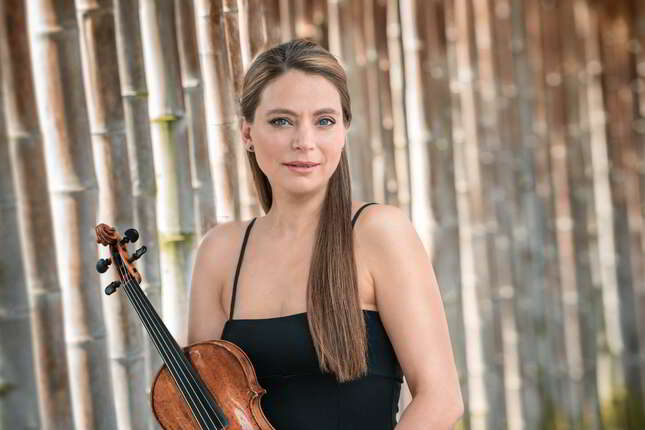
Zunächst sieht in Franziska Pietschs Leben alles nach einer klassischen Bilderbuchkarriere aus: geboren in eine Ost-Berliner Musiker-Familie – beide Eltern sind Geiger – sorgt Franziska Pietsch als Wunderkind für Furore. Unter der Ägide von Prof. Werner Scholz an der Hochschule für Musik Hanns Eisler in Berlin gewinnt sie erste Preise und debütiert mit elf Jahren in der Komischen Oper Berlin. Es folgen Jahre „im Virtuosen-Zirkus“ wie die Geigerin diese Zeit rückblickend charakterisiert. Sie spielt mit den großen Orchestern der DDR Violinkonzerte von Bruch, Lalo, Sibelius oder Paganini. Mit 12 Jahren spielt sie erste Aufnahmen für den Rundfunk der DDR ein, u.a. Sarasates „Zigeunerweisen“. 1984 endet diese Bilderbuchkarriere abrupt, als der Vater nach einer Tournee im Westen bleibt. Zwei Jahre dauert es, bis die Familie nachziehen kann. Diese Jahre prägen Franziska Pietsch für ihr ganzes Leben. Sie ist von heute auf morgen ganz auf sich selbst gestellt, da staatliche Förderung und Unterricht wegbrechen.  „Ich war dadurch gezwungen, mir mit 14 Jahren die grundlegenden Fragen zu stellen: Warum möchte ich Musikerin sein? Was bedeutet Musik wirklich? Welchen Weg möchte ich im Leben gehen?“ Franziska Pietsch findet Antworten bei Johann Sebastian Bach, den sie für sich entdeckt. Ein Jahr lang beschäftigt sie sich ganz ohne Lehrer ausschließlich mit Bachs SoloWerken und verabschiedet sich ganz bewusst von der wunderkindlichen Virtuosen-Manege. „Bach war meine Rettung, meine Heilung. Ich habe plötzlich gespürt, dass große Musik Botschaften vermitteln kann, die über Jahrhunderte hinweg Bestand haben. In denen ich meine Seele wiederfinde und ausdrücken kann.“ Nach der Ausreise in die Bundesrepublik 1986 geht Franziska Pietsch diesen Weg konsequent weiter, unterstützt von ihrem Lehrer und Mentor im Westen, Prof. Ulf Hoelscher. Ihre Lehrjahre schließt Franziska Pietsch anschließend an der Juilliard School in New York bei der legendären Geigen-Pädagogin Dorothy DeLay ab. Franziska Pietsch ist Gewinnerin mehrerer internationaler Wettbewerbe wie u.a. dem Bach Wettbewerb für Kinder und Jugendliche in Leipzig und Maria Canals in Barcelona. 1992 kehrt Franziska Pietsch nach Deutschland zurück und setzt ihre solistische Laufbahn mit Orchestern wie der Budapester Philharmonie, den Dortmunder Symphonikern, der Krakauer Philharmonie fort und arbeitet mit Dirigenten wie Arpad Joò, Moshe Atzmon und Julia Jones zusammen. Dennoch beschließt sie, Musik nicht nur aus der Perspektive der Solistin erleben zu wollen, sondern alle Formen des Musizierens intensiv kennen zu lernen, vor allem die großen Meisterwerke der sinfonischen Literatur. So ist sie über zehn Jahre gefragte Konzertmeisterin in renommierten Orchestern wie dem Orchestre Philharmonique du Luxembourg, dem Sinfonieorchester Wuppertal, der Deutschen Oper am Rhein oder der Frankfurter Oper. Parallel dazu konzertiert Franziska Pietsch weiterhin als Solistin in ganz Europa, Amerika und Asien. 2010 beendet sie ihre Konzertmeistertätigkeit und widmet sich nunmehr gänzlich der Kammermusik. Mit dem Trio Testore spielt sie für das Label audite u.a. sämtliche Klavier-Trios von Johannes Brahms ein. 2014 gibt Franziska Pietsch das Klaviertrio zugunsten ihrer „Herzensformation“, dem Streichtrio, auf. Mit der Bratschistin Sophia Reuter und dem Cellisten Johannes Krebs gründet sie das Trio Lirico, das Werke von Max Reger auf CD einspielt. Ein besonderes internationales Kritiker-Echo (u.a. Nominierung für den Preis der Deutschen Schallplattenkritik) rufen die Konzerte und Einspielungen mit dem Pianisten Detlev Eisinger (Sonaten von Grieg, Franck, Prokofiev u.a.) hervor. 2017 ist für Franziska Pietsch die Zeit gekommen, ihre persönlichen und musikalischen (Grenz-) Erfahrungen wieder verstärkt in großen Violinkonzerten Klang werden zu lassen. Mit dem Deutschen Symphonie-Orchester Berlin unter Leitung von Cristian Măcelaru spielt sie die beiden Prokofiev-Konzerte ein. Dem Komponisten fühlt sie sich seit Kindheitstagen seelenverwandt:„Es sind nicht nur die melancholischen, oft dunklen und düsteren Klangfarben, die möglicherweise meine tschechisch-polnischen Wurzeln besonders ansprechen, sondern vielleicht auch Prokofievs eigene Geschichte: seine Suche nach einer eigenen künstlerischen Identität in einem totalitären Regime.“ Die bei audite erschienene CD begeistert die internationale Kritik. Sie wurde für den International Classic Music Award nominiert und mit dem Vierteljahrespreis der Deutschen Schallplattenkritik ausgezeichnet. Ebenfalls mit der im Herbst 2018 veröffentlichten Solo CD mit Werken von Bartok, Ysaye und Prokofiev stellte die Künstlerin einmal mehr ihre große künstlerische Bandbreite unter Beweis und erntete großen Zuspruch von Seiten der Musikkritik. Die erfolgreiche Zusammenarbeit mit dem CD Label audite wird Franziska Pietsch auch in der Saison 2019/20 fortsetzen. Im Herbst 2019 stellte sie in einer Aufnahme mit ihrem Trio Lirico Werke von Schnittke, Penderecki und Weinberg vor. Mit ihrem neuen Duo Partner Josu de Solaun hatte Pietsch bereits im Frühjahr 2019 die erste gemeinsame Einspielung vorgelegt. Auch diese CD Veröffentlichungen wurden für bedeutende Musikpreise 2020 nominiert. Im Sommer 2020 erscheint bereits die nächste Einspielung von Franziska Pietsch und Josu de Solaun, mit Kompositionen von Fauré, Debussy, Ravel und Poulenc.
Gramophone

Rezension Gramophone March 2018 | Peter Quantrill | 1. März 2018 Once read, it's hard to forget, but best to lay aside Reger's claim for his Op...

Once read, it's hard to forget, but best to lay aside Reger's claim for his Op 77b String Trio as satisfying the demands of his age for a new Mozart. 'Even more beautiful' it may be than the Flute Serenade with which it shares an opus number, but the trio's least far-fetched claim to cast some flickering shadow of Mozartian lightness of spirit lies in a divertimento-like character most pleasingly heard in a Larghetto which shares the formal, spacious layout and grave beauties of the gardens in Potsdam and the Nymphenburg. The rough, stamping humour of the subsequent Scherzo rather coarsely banishes any lingering illusion of imperial (or Classical) finesse, though the finale makes partial amends with a Haydnesque turn of dialogue and brevity.

If the steam of dumplings still rises from Reger's better-known chamber and orchestral music for some listeners – I'm rather partial to a dish of Griessklösschen myself – then they should find the calorie count more to their taste in the attenuated textures of the string trio, even in the more densely woven lines of Op 141b. The German Trio Lirico do a fine job of sounding more like a sextet, not without some effort caught by the microphones. Rival ensembles on Naxos and Gramola are also audibly taxed – somehow huffing and sighing are grist to the mill of the Regerian aesthetic – but I prefer the ebb and flow of the new recording, the opportunities for contrast and genial dialogue taken wherever they arise, such as in the serenade-like lilt of the first movement's second theme.

The Second Piano Quartet is one of those several works composed after Reger had had a close encounter with a Brahmsian archetype (in this case the C minor Quartet, Op 60), and there is even a furtive tip of the hat to his exemplar at the start of the development section. Here again a sympathetic recording balance is key to the success of the performance, placing Detlev Eisinger's contribution at a discreet distance while making clear that this is a partnership of musical equals.

Suche in...

...