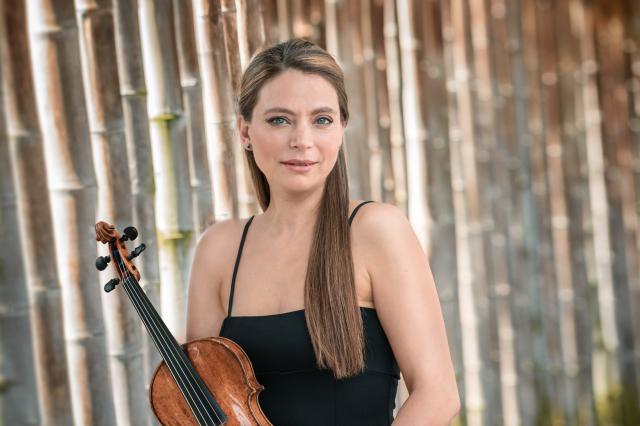
The three composers here lived on the eastern side of the Iron Curtain, as did two members of Trio Lirico, violinist Franziska Pietsch and violist Sophia Reuter. As Pietsch writes in the liner notes, “As children, we both lived in East Berlin and were close friends already then. We therefore share a personal history, a similar style of playing, and a similar non-verbal way of communicating about this music. We just feel it.” Indeed they do! Nor could they have a better partner than cellist Johannes Krebs. They converse with their magnificent instruments, giving the music perfect terraced balance. Pietsch uses bow pressure to create everything from brusk intensity in fortissimo passages to just enough vibrato to produce a comforting pianissimo. Because Trio Lirico’s grasp of the form of each work is so integral, its use of retards and rubato never interferes with the flow. The peerless engineering in Berlin’s Jesus Christus Church lets you “set it and forget it” so you can concentrate fully on the music.
This is especially true of the Trio (1950) by Vainberg, a soul brother of Shostakovich. Even the way Lirico links the extremely soulful I to II with just an inhale of a pause, and then does the same thing between the movements of all the works here, conveys the wholeness with which they conceive each work. Even Shostakovich himself would weep over the gorgeous sounds and musicianship in II, a lament “sung” over a fugue. In III the viola takes the lead with the cello supplying the bass line and the violin the pulse. What pacing the Lirico offer—persistent yet flexible, with tension created by their careful attention to note values that “speed up” from whole note to half to quarter to eighth notes, etc.
Krzysztof Penderecki’s Trio (1991) is, needless to say, sui generis. It opens with three sets of shouting chords after which each instrument has a cadenza. All the basic, seemingly independent materials are thus laid out, then brought together over the course of two movements, the first more recitative, the second Vivace, as the Trio ends as it began. The work is brilliantly constructed; emotional as the players make it, I hear it more as intellectual construct.
Pietsch comments on Alfred Schnittke’s Trio (1985): “This music, magnificent as it is, also has a certain coldness to it, something frightening. The trio begins with a variant of ‘Happy Birthday’, though what follow is no happy serenade but music without mercy. For me, this clearly is an analysis of death.” If there are bits of ‘Happy Birthday’ in it, I sure didn’t hear it. It strikes me as a really angry work—the first time I’ve ever used that word to describe a piece of music. I hear grimness drawn out of chorale-like chords, interrupted with momentary folk-like relief (like snippets Charles Ives might have dropped in) before returning to the torment. After 25 minutes, I could detect no organization to this seemingly repetitive work. It reminds me of how Woody Allen movies too often make me respond: “Enough of your neuroses! Go tell them to your shrink.” Nonetheless, the powerful Trio Lirico holds its grip on the work from start to finish.
In brief, these are peerless performances of music from troubled times, a lesson in how to make ugliness beautiful. That sounds like a task for our increasingly war-like times.