Ihre Suchergebnisse (9960 gefunden)

Neuigkeit Aug 4, 2015 News Klosterkirche Muri als Tonstudio

Impressions of the recording situation of the CD production of the Muffat Messe "Missa in labore requies". The Cappella Murensis and the ensemble Les Cornets Noirs make perfect use of the four galleries in the Abbey Church of Muri.​

Neuigkeit Aug 11, 2015 News Mandelring’s Mendelssohn Edition CD of the Week at rbb

CD DER WOCHE | 10.08. - 16.08.2015
Felix Mendelssohn Bartholdy: "Complete Chamber Music for Strings"
Beate Stender, kulturradio


Bislang gab es die vielgelobte Einspielung der gesamten Kammermusik für Streicher vom Mandelring Quartett auf vier einzelnen CDs. Jetzt ist die Gesamt-Edition erschienen.

Entweder ganz oder gar nicht. Wenn sich das Mandelring Quartett einen Komponisten vorknöpft, dann nur mit all seinen Werken. Nach seinen Gesamteinspielungen der Streichquartette von Schostakowitsch und Janáček hat sich das Ensemble Felix Mendelssohn Bartholdy zugewandt. Dazu gehören sechs Streichquartette, zwei Quintette und das Oktett. Als Gäste machen der Bratschist Günter Teuffel und das Quartetto di Cremona das Ensemble komplett. Die vier CDs der Mendelssohn-Gesamtaufnahme sind nun in einer Box erschienen.
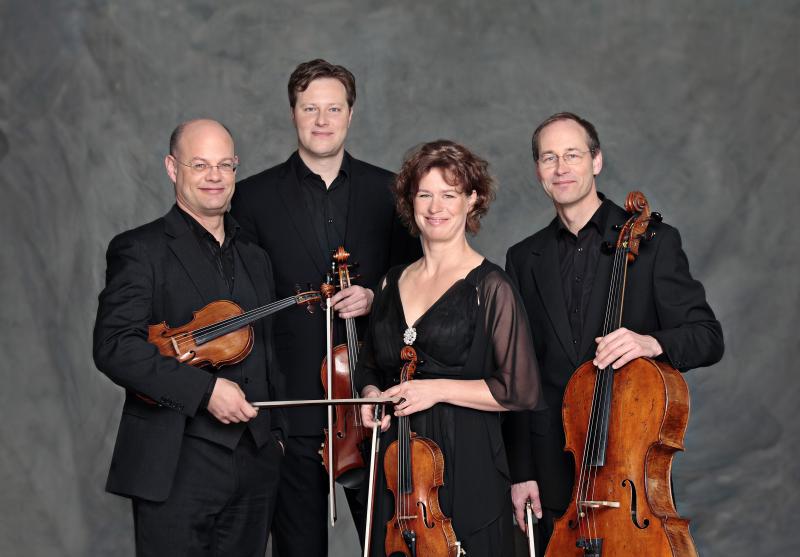
Das Mandelring-Quartett, v.l.n.r.: Bernhard Schmidt (Violoncello), Nanette Schmidt (Violine), Roland Glassl, Viola, Sebastian Schmidt (Violine), Foto: Martin Blume
 
Hochexpressiv und subtil

Die vier Musiker des Mandelring Quartetts sind perfekt aufeinander abgestimmt: seit dreißig Jahren musizieren sie schon als Quartett zusammen und drei der vier Musiker sind Geschwister. So betont der Cellist Bernhard Schmidt: „Das Geschwisterverhältnis trägt dazu bei, dass wir ähnliche Einflüsse gemeinsam erlebt haben und wir über eine sehr lange Zeit ein gemeinsames Klangideal formen konnten."

Dieses gemeinsame Klangideal hört man auch in der Gesamteinspielung. Ihr Mendelssohn klingt differenziert: von romantisch-sensibler Fröhlichkeit bis zu nachdenklichen und grüblerisch-schmerzvollen Ahnungen.

Bernhard Schmidt erzählt über die gemeinsame Arbeit an der Mendelssohn-Gesamtaufnahme, die sich über ein ganzes Jahr erstreckte:  „Man muss bei Mendelssohn mehr und geschickter Regie führen innerhalb des musikalischen Ablaufs als bei anderen Komponisten. Sonst lässt man sich von der Begeisterung und den langen Steigerungen mitreißen und irgendwann klebt man sozusagen emotional an der Decke. Da muss man sich bewusst zurücknehmen."

So entstand eine klug durchdachte und sehr subtile Interpretation. Der Verstand behält hier jedoch nicht das letzte Wort. Das Mandelring Quartett spielt mit so großer Hingabe und Mühelosigkeit, dass man sofort spürt, wie nahe ihnen diese Musik ist. Dieser Mendelssohn ist eine absolute Herzensangelegenheit.

Neuigkeit Aug 21, 2015 | Sabine Wiedemann News Video Jacques Thibaud String Trio

​On September 4th audite presents the second album with the Jaques Thibaud String Trio: Beethoven's Complete String Trios on 2 CDs. As a preview watch and hear impressions from the recording session and the new recording in the video.

The five String Trios are masterpieces of the young Ludwig van Beethoven as he travels towards the string quartet: however, many musicians and scholars have preferred the mature Trios Op. 9 to the subsequent String Quartets Op. 18. With their new double CD, the Thibaud Trio provide an opportunity to rediscover these milestones in the history of the string trio.

Following the successful release of String Trios by Cras, Reger, Dohnányi and Kodály (aud. 97.534), the Jacques Thibaud String Trio are now turning towards a Classical composer, with a new audite complete recording of the Beethoven String Trios.
It is not always clear why certain genres make it into the pantheon of musical history, whilst others remain "insiders' tips". The string quartet undoubtedly belongs to the former category, whilst the string trio - despite brilliant works such as Mozart's Divertimento K563 or the Beethoven String Trios - forms part of the latter. The trio formation consisting of a violin, viola and cello is generally deemed to produce a thin sound and to have been neglected by composers. With Beethoven, however, the opposite is true: for the young Beethoven, the trio was a touchstone of his mastery of this form "without piano", in which he found himself as a composer.
He left five trios in all, in Opp. 3 and 8 turning towards the traditions of the divertimento and the serenade, whilst producing new and sophisticated reinterpretations of these forms. His Trios Op. 9, written in 1796-98, became his calling card as a composer for string instruments. All the characteristics of the mature Beethoven can be found here: astonishing sonorities; a sense of the character and personalities of the three instruments; using few, concise themes; drama and sensuousness.

Neuigkeit Sep 16, 2015 | Wencke Wallbaum News & Artists & Release Heinz Holliger gets Swiss Grand Award for Music 2015

​Holliger, who is currently on tour in Japan, accepted the award by live video link during the presentation ceremony in Basel Cathedral attended by Federal Councillor Alain Berset. Chosen from among 15 nominees by the Federal Music Jury, he receives the sum of CHF 100,000.
Here you can read the full text of the honorific speech:

Neuigkeit Sep 25, 2015 | Schweizer Klaviertrio – Swiss Piano Trio Artists The Swiss Piano Trio on its 10th Latin America tour

From 28 September until 10 October, the Swiss Piano Trio will be on its 10th concert tour in Latin America. The ensemble will perform in renowned concert series like Sociedad Filarmónica de Lima, Fundacion Beethoven in Santiago de Chile and Asociación Nacional de Conciertos in Panama. In all three countries, the musicians will also teach in masterclasses. The Swiss Piano Trio will perform on this trip the piano trio in E flat major op. 70,2 by Ludwig van Beethoven, which will be part of volume III of its complete Beethoven recording, the Moments Musicaux by Swiss composer Rudolf Kelterborn and Mendelssohn's virtuoso piano trio in d minor op. 49.

Neuigkeit Nov 10, 2015 | Sabine Wiedemann News Video Anne-Cathérine Heinzmann / Thomas Hoppe

W​atch impressions from the recording session with Anne-Cathérine Heinzmann (flute) and Thomas Hoppe (piano) for Schulhoff - Smit - Gál - Raphael - Tansman (Works for Flute and Piano) - their second audite album.  Check out also the artists'  first album with works by French composers (Poulenc, Hindemith, Dutilleux , Muczynski, Martin; audite 92.667).

Five intensive and virtuoso works by five composers of the 20th century. In their respective aesthetics, each composer shares the ability to use forms and models of music history as inspiration for his own modern musical language. Existentially, they shared a common fate: all were persecuted by the National Socialists. Some were murdered in concentration camps and others fled to continue their lives in exile.

Leo Smit, Alexandre Tansman and Erwin Schulhoff were inspired by French music, including Claude Debussy's sense for the magic of sound and melodic elaboration and the openness towards jazz shown by the Parisian musical scene. For Günter Raphael, classical clarity and romantic differentiation were decisive ideals; in his late Intermezzi, Hans Gál looked back at his artistic origins in the circle surrounding Johannes Brahms. These five intensive, virtuoso works shed light on facets of an age to which attention is otherwise but rarely paid.

Suche in...

...