







Add download to your cart
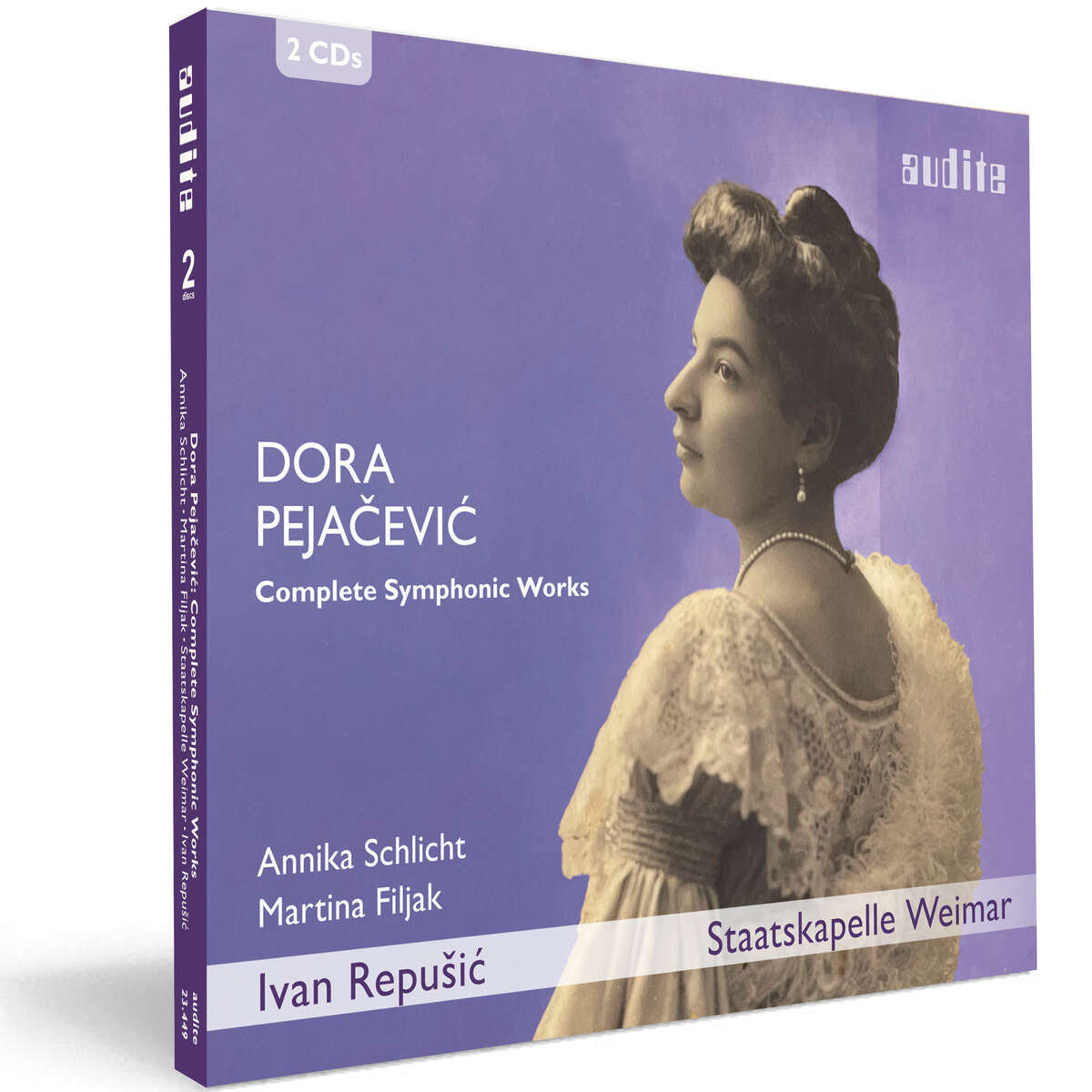
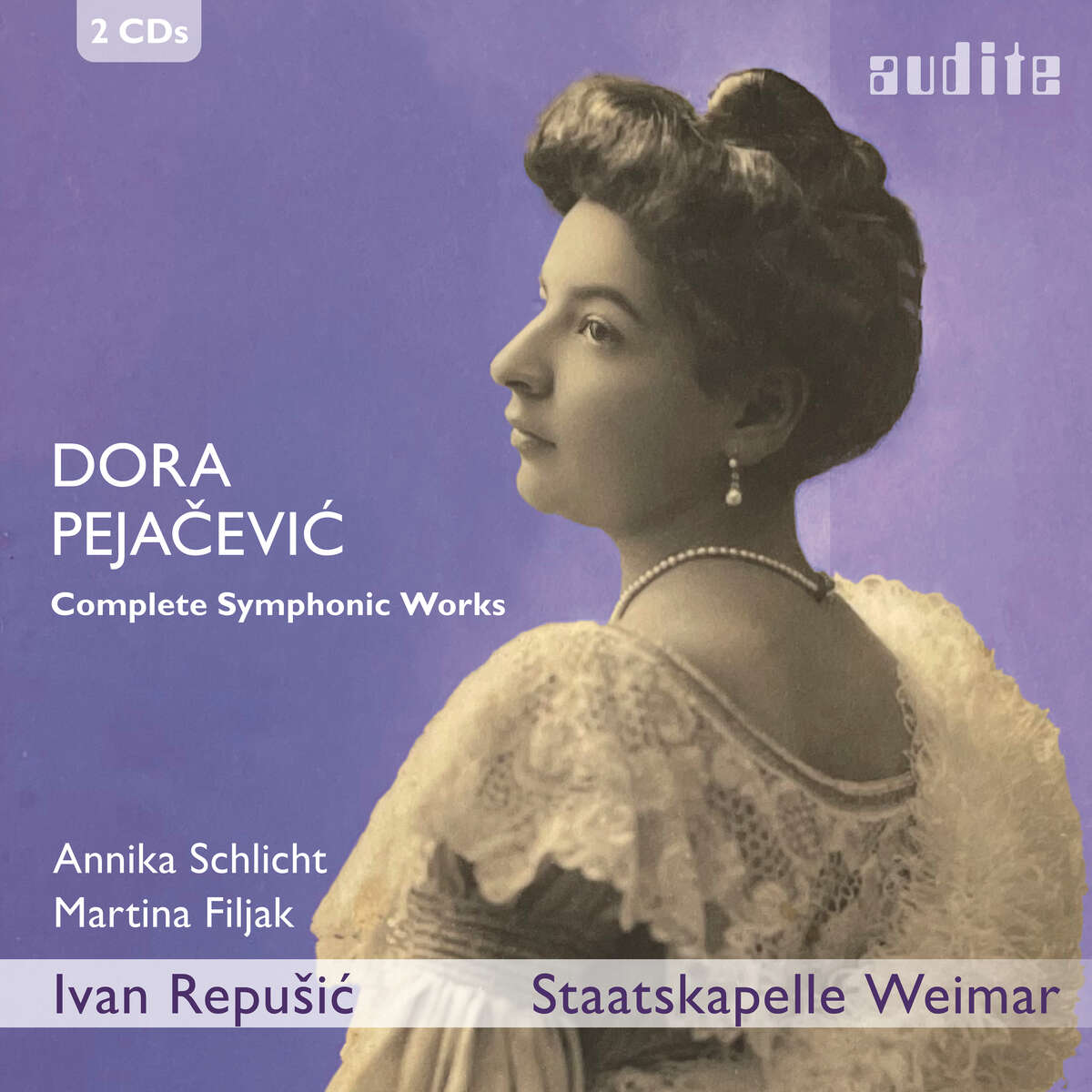
Dora Pejačević regarded her Symphony as her most important work. Yet at its premiere, one crucial detail was missing: her full name. In the programmes for the first performances in Vienna and Dresden, only “D. Pejacsevich” was listed. Why did the composer refrain from including her first name? And would the audience have reacted differently if they had known that the Symphony was written by a woman?more
Dora Pejačević


"Dokumente einer Moderne, die hier mit glühendem Feuer und greifbarem Engagement eingespielt wurden." (NMZ)


Track List
CD 1 von 2 (55:10)
Dora Pejačević Zwei Schmetterlingslieder, Op. 52 (02:47) Annika Schlicht | Staatskapelle Weimar | Ivan Repušić
CD 2 von 2 (55:03)
Dora Pejačević Phantasie concertante in D Minor, Op. 48 (16:05) Martina Filjak | Staatskapelle Weimar | Ivan Repušić
Dora Pejačević Piano Concerto in G Minor, Op. 33 (29:00) Martina Filjak | Staatskapelle Weimar | Ivan Repušić
Details
| Dora Pejačević: Complete Symphonic Works | |
| article number: | 23.449 |
|---|---|
| EAN barcode: | 4022143234490 |
| price group: | BCE |
| release date: | 6. March 2026 |
| total time: | 110 min. |
Bonus Material
Informationen
Is there such a thing as "female" and "male" music? The life of Croatian composer Dora Pejačević clearly shows that - like many other women composers of the late 19th and early 20th centuries - she had far fewer opportunities in the musical world than her male colleagues. Yet her aristocratic background and a mother who was herself a composer afforded her certain freedoms. Step by step, Pejačević found her way into concert programmes throughout the Habsburg Monarchy, with works ranging from piano and vocal music to the symphony, a genre traditionally considered "male."
The reception of her music illustrates how difficult it is to classify music according to gender: while some critics described her compositions as "feminine", others recognised in them a "masculine" expressive power. What remains beyond doubt, however, is Dora Pejačević's artistic significance - as one of the most outstanding women composers of her era.
Reviews

RBB Kulturradio | rbb Radio 3 "Album der Woche | Sommer-Best-of mit Verlosung" | Cornelia de Reese | August 10, 2026 | source: https://www.radi...
BROADCAST: Album der Woche | Sommer-Best-of mit Verlosung
Dora Pejačević: Complete Symphonic Works
Die kroatische Komponistin Dora Pejačević ist außerhalb ihrer Heimat erst wenig bekannt. Der gleichfalls kroatische Chefdirigent der StaatskapelleMehr lesen
Die kroatische Komponistin Dora Pejačević ist außerhalb ihrer Heimat erst wenig bekannt. Der gleichfalls kroatische Chefdirigent der Staatskapelle Weimar, Ivan Repušic, will das ändern. Mit seinem Orchester hat er alle symphonischen Werke eingespielt, inklusive der Orchesterlieder, die die Komponistin hinterlassen hat. Im März ist dieses Doppelalbum erschienen und war unser "Album der Woche". Jetzt ist es das fünfte von acht Alben in unserem Sommer-Best-of.
Es war eine unbeschwerte Kindheit, die Maria Theodora Paulina Pejačević im elterlichen Schloss in Našice genoss. Damals gehörte der Ort noch zu Slowenien. Ihre aristokratische Musikausbildung auf Klavier und Violine fiel auf talentierten Boden. Schon im Teenager-Alter schrieb sie erste Werke à la Robert Schumann.
Genau diese sind heute in Kroatien weit verbreitet – vor allem in den Klavierschulen des Landes. So erlebte auch Dirigent Ivan Repušic seinen Erstkontakt mit Dora Pejačević: im Klavierunterricht spielte er ihre Klavierminiaturen: "Natürlich wusste ich zu jener Zeit noch nicht, dass ich mich eines Tages so intensiv ihren symphonischen Werken widmet würde."
Ein Leben in spannungsreicher Zeit
Ihre Musik ist Spiegel ihres Lebens. 1885 geboren, wächst sie im Lebensgefühl des Fin de Siècle auf, erlebt den Zusammenbruch der k.u.k. Monarchie und die Gründung Kroatiens. Im Ersten Weltkrieg half sie als Krankenschwester – ein Affront in Adelskreisen. Kritisch auf ihre Familie blickend schreibt sie ihrer besten Freundin: "Ich weiß gar nicht, wie man ohne Arbeit leben kann."
Unbeirrt vertieft die unabhängige junge Frau ihre Musikstudien in Budapest, München, Wien und Berlin. Ihr Freundeskreis zeigt sich mehr als verwundert, als die so auf Eigenständigkeit pochende Dora Pejačević doch heiratet. Doch diese Lebensphase ist kurz, nach nicht einmal zwei Jahren endet ihr Leben, kurz nach der Geburt ihres Sohnes.
Renaissance ihrer Werke
Ivan Repušic betont: "Sie ist im Alter von nicht einmal 38 Jahren gestorben und fast 50 Jahre nach ihrem Tod war sie nahezu völlig unbekannt. Erst in Kroatien in den 1970er Jahren begann langsam ein erneutes Interesse an ihren Werken. Und ich bin glücklich, dass eine gewisse Renaissance ab 2000 nicht nur in Kroatien, sondern in der Welt begann. Das freut mich sehr."
Die sinfonischen Kompositionen stammen aus ihrer reifen Phase und wurden zu ihren Lebzeiten in ganz Europa aufgeführt – auch, wenn sie eine Frau war.
Nun sind ihre Kompositionen auf einem Doppelalbum wiederzuentdecken. Eröffnet wird es mit einem besonderen Lied, so Dirigent Ivan Repušic: "Das Orchesterlied 'Verwandlung' am Anfang ist meiner Meinung nach eines der eindrucksvollsten Werke von Dora Pejačević. Das Stück entstand in den düsteren Tagen des Ersten Weltkriegs, was sich auch in der Orchesterbesetzung widerspiegelt, die in erster Linie aus tiefen Streichern besteht. Es erinnert mich an Brahms' 'Requiem', man nutzt also eher tiefe Streicher wie Bratschen, Celli und Kontrabässe."
Solistinnen mit kroatischen Berührungspunkten
Solistin der Orchesterlieder ist Mezzosopranistin Annika Schlicht, die Ivan Repušic gezielt für das Projekt angesprochen hat. Seine Wahl begründet er: "Es ist nicht das erste Mal, dass sie Werke aus dem kroatischen Bereich, von kroatischen Komponisten gesungen hat. Sie hat auch vor einigen Jahren ein kroatisches Requiem von Igor Kuljerić mit einem Riesenerfolg gesungen. Ihre Stimme passt wunderbar zu diesen Liedern."
Ebenso ist hier das Klavierkonzert von Dora Pejačević zu hören, mit der kroatischen Pianistin Martina Filjak, die in dem Konzert viele ihrer eigenen rebellischen Wesenszüge entdeckt. Dessen zweiten Satz schätzt der Dirigent besonders: "Irgendwie erscheint mir dieser Satz unglaublich reif und es ist mir immer noch schwer verständlich, dass ein so komplexes Klavierkonzert tatsächlich ihr erstes Orchesterwerk überhaupt ist!"
Eine große Sinfonie
Das Zentrum des Albums ist Dora Pejačevićs Sinfonie in fis-Moll. 1920 ist die gesamte Sinfonie vom Dresdner Philharmonischen Orchester uraufgeführt worden. Hier hört man, dass sie eine Komponistin ist, die, wie sie selbst schrieb, in "Trance der musikalischen Besessenheit" komponierte.
"Der erste Satz führt einen wunderbar ins komplexe Werk ein. Der zweite Satz hat einen wunderschönen Anfang und eine ganz lyrische, elegische und düstere Stimmung – besonders mit diesem Englisch-Horn-Solo. Der dritte Satz, ein Tanz, ist vielleicht mein Favorit. In diesem Satz spüre ich die slavische Seele von Dora Pejacevic."
Mit traditionsreichem Orchester
Die Staatskapelle Weimar ist eine Idealbesetzung. Die Musikerinnen und Musiker sind mit der spätromantischen Klangfülle hörbar vertraut, denn Persönlichkeiten wie Richard Strauss, Franz Liszt und Richard Wagner haben hier gewirkt und Uraufführungen gefeiert. Und diese spätromantische Tradition lebt auch in den Werken von Dora Pejačević. So bringt die Staatskapelle Weimar unter Ivan Repušic diese Musik zum dichten, lebendigen Schillern und Beben, mit hervorragenden Bläsereinwürfen und dichten Streicherepisoden.
Es war eine unbeschwerte Kindheit, die Maria Theodora Paulina Pejačević im elterlichen Schloss in Našice genoss. Damals gehörte der Ort noch zu Slowenien. Ihre aristokratische Musikausbildung auf Klavier und Violine fiel auf talentierten Boden. Schon im Teenager-Alter schrieb sie erste Werke à la Robert Schumann.
Genau diese sind heute in Kroatien weit verbreitet – vor allem in den Klavierschulen des Landes. So erlebte auch Dirigent Ivan Repušic seinen Erstkontakt mit Dora Pejačević: im Klavierunterricht spielte er ihre Klavierminiaturen: "Natürlich wusste ich zu jener Zeit noch nicht, dass ich mich eines Tages so intensiv ihren symphonischen Werken widmet würde."
Ein Leben in spannungsreicher Zeit
Ihre Musik ist Spiegel ihres Lebens. 1885 geboren, wächst sie im Lebensgefühl des Fin de Siècle auf, erlebt den Zusammenbruch der k.u.k. Monarchie und die Gründung Kroatiens. Im Ersten Weltkrieg half sie als Krankenschwester – ein Affront in Adelskreisen. Kritisch auf ihre Familie blickend schreibt sie ihrer besten Freundin: "Ich weiß gar nicht, wie man ohne Arbeit leben kann."
Unbeirrt vertieft die unabhängige junge Frau ihre Musikstudien in Budapest, München, Wien und Berlin. Ihr Freundeskreis zeigt sich mehr als verwundert, als die so auf Eigenständigkeit pochende Dora Pejačević doch heiratet. Doch diese Lebensphase ist kurz, nach nicht einmal zwei Jahren endet ihr Leben, kurz nach der Geburt ihres Sohnes.
Renaissance ihrer Werke
Ivan Repušic betont: "Sie ist im Alter von nicht einmal 38 Jahren gestorben und fast 50 Jahre nach ihrem Tod war sie nahezu völlig unbekannt. Erst in Kroatien in den 1970er Jahren begann langsam ein erneutes Interesse an ihren Werken. Und ich bin glücklich, dass eine gewisse Renaissance ab 2000 nicht nur in Kroatien, sondern in der Welt begann. Das freut mich sehr."
Die sinfonischen Kompositionen stammen aus ihrer reifen Phase und wurden zu ihren Lebzeiten in ganz Europa aufgeführt – auch, wenn sie eine Frau war.
Nun sind ihre Kompositionen auf einem Doppelalbum wiederzuentdecken. Eröffnet wird es mit einem besonderen Lied, so Dirigent Ivan Repušic: "Das Orchesterlied 'Verwandlung' am Anfang ist meiner Meinung nach eines der eindrucksvollsten Werke von Dora Pejačević. Das Stück entstand in den düsteren Tagen des Ersten Weltkriegs, was sich auch in der Orchesterbesetzung widerspiegelt, die in erster Linie aus tiefen Streichern besteht. Es erinnert mich an Brahms' 'Requiem', man nutzt also eher tiefe Streicher wie Bratschen, Celli und Kontrabässe."
Solistinnen mit kroatischen Berührungspunkten
Solistin der Orchesterlieder ist Mezzosopranistin Annika Schlicht, die Ivan Repušic gezielt für das Projekt angesprochen hat. Seine Wahl begründet er: "Es ist nicht das erste Mal, dass sie Werke aus dem kroatischen Bereich, von kroatischen Komponisten gesungen hat. Sie hat auch vor einigen Jahren ein kroatisches Requiem von Igor Kuljerić mit einem Riesenerfolg gesungen. Ihre Stimme passt wunderbar zu diesen Liedern."
Ebenso ist hier das Klavierkonzert von Dora Pejačević zu hören, mit der kroatischen Pianistin Martina Filjak, die in dem Konzert viele ihrer eigenen rebellischen Wesenszüge entdeckt. Dessen zweiten Satz schätzt der Dirigent besonders: "Irgendwie erscheint mir dieser Satz unglaublich reif und es ist mir immer noch schwer verständlich, dass ein so komplexes Klavierkonzert tatsächlich ihr erstes Orchesterwerk überhaupt ist!"
Eine große Sinfonie
Das Zentrum des Albums ist Dora Pejačevićs Sinfonie in fis-Moll. 1920 ist die gesamte Sinfonie vom Dresdner Philharmonischen Orchester uraufgeführt worden. Hier hört man, dass sie eine Komponistin ist, die, wie sie selbst schrieb, in "Trance der musikalischen Besessenheit" komponierte.
"Der erste Satz führt einen wunderbar ins komplexe Werk ein. Der zweite Satz hat einen wunderschönen Anfang und eine ganz lyrische, elegische und düstere Stimmung – besonders mit diesem Englisch-Horn-Solo. Der dritte Satz, ein Tanz, ist vielleicht mein Favorit. In diesem Satz spüre ich die slavische Seele von Dora Pejacevic."
Mit traditionsreichem Orchester
Die Staatskapelle Weimar ist eine Idealbesetzung. Die Musikerinnen und Musiker sind mit der spätromantischen Klangfülle hörbar vertraut, denn Persönlichkeiten wie Richard Strauss, Franz Liszt und Richard Wagner haben hier gewirkt und Uraufführungen gefeiert. Und diese spätromantische Tradition lebt auch in den Werken von Dora Pejačević. So bringt die Staatskapelle Weimar unter Ivan Repušic diese Musik zum dichten, lebendigen Schillern und Beben, mit hervorragenden Bläsereinwürfen und dichten Streicherepisoden.
Die kroatische Komponistin Dora Pejačević ist außerhalb ihrer Heimat erst wenig bekannt. Der gleichfalls kroatische Chefdirigent der Staatskapelle

Die Tonkunst | Juli 2026, Nr. 3, Jg. 20 (2026) | Lukas Mantovan | July 1, 2026
Repušić beweist, mit Feingefühl und Energie den vielen Schichten des Werkes gerecht zu werden, verliert sich ein wenig in der Polyphonie des ersten Satzes, besticht aber mit Charme, Witz und Lyrik in den Mittelsätzen.Mehr lesen
Aus urheberrechtlichen Gründen dürfen wir ihnen diese Rezension leider nicht zeigen!
Repušić beweist, mit Feingefühl und Energie den vielen Schichten des Werkes gerecht zu werden, verliert sich ein wenig in der Polyphonie des ersten Satzes, besticht aber mit Charme, Witz und Lyrik in den Mittelsätzen.

Diapason | N° 756 JUIN 2026 | Thomas Deschamps | June 1, 2026
Les quatre lieder avec orchestre qui ouvrent le double album captivent d’emblée. Figure majeure de la musique croate, Dora Pejacevic y impose uneMehr lesen
Les quatre lieder avec orchestre qui ouvrent le double album captivent d’emblée. Figure majeure de la musique croate, Dora Pejacevic y impose une sensibilité puissante et singulière, en particulier chez Karl Kraus (Verwandlung) et Rainer Maria Rilke (Liebeslied), poètes dont elle était l’amie. Riche mais jamais surchargé, l’écrin instrumental veille à l’intelligibilité des mots tout en développant un lyrisme dont la sensualité se compare à celle d’un Chausson. Le mezzo capiteux et ensoleillé d’Annika Schlicht, lové dans l’accompagnement attentif que lui offrent Ivan Repusic et la Staatskapelle de Weimar, séduit pleinement – et surclasse sans peine le premier enregistrementde cespages chez CPO dix ans plus tôt.
Née dans une famille fortunée de l’aristocratie, elle compléta en autodidacte une formation entamée à Budapest et poursuivie à Dresde, qu’elle jugeait insuffisante. Portant l’empreinte de son admiration pour Rachmaninov, le Concerto pour piano en sol mineur (1916) déploie majestueusement des thèmes au romantisme fiévreux et une virtuosité que Pejacevic poussera plus loin encore dans sa Fantaisie concertante en ré mineur (1919).
Datant de la même année et partageant la même tonalité, l’Ouverture est une vraie merveille. Cette vivacité et ce relief, ce parfum de Vienne fin-de-siècle illustreraient parfaitement les bandes d’un Max Ophuls. Avec la Symphonie en fa dièse mineur (1918), Pejacevic atteint un palier supplémentaire. Prenons l’Andante sostenuto : le discours d’abord grave et lancinant voit ses lignes s’épanouir et tendre vers la lumière comme les fleurs d’un riche jardin d’hiver. Le Scherzo bondit, rêve, scintille, resplendit avec un entrain magnifiquement rendu par les interprètes.
Les équilibres peaufinés par Ivan Repusic et relayés par une très efficace prise de son, l’engagement des musiciens de la Staatskapelle Weimar feront passer sur des timbres parfois un rien prosaïques. On songe à ce que donneraient dans ces pièces les phalanges de Vienne ou Budapest…
Apôtre d’un Jugendstil musical, Dora Pejacevic s’éteint à trente-sept ans des suites d’un accouchement compliqué. On peut regarder le charmant dessin animé que lui a consacré La Boîte à Pépites sur sa chaîne YouTube mais surtout il faut écouter cette musique qui laisse toujours à l’auditeur un espace à soi.
Née dans une famille fortunée de l’aristocratie, elle compléta en autodidacte une formation entamée à Budapest et poursuivie à Dresde, qu’elle jugeait insuffisante. Portant l’empreinte de son admiration pour Rachmaninov, le Concerto pour piano en sol mineur (1916) déploie majestueusement des thèmes au romantisme fiévreux et une virtuosité que Pejacevic poussera plus loin encore dans sa Fantaisie concertante en ré mineur (1919).
Datant de la même année et partageant la même tonalité, l’Ouverture est une vraie merveille. Cette vivacité et ce relief, ce parfum de Vienne fin-de-siècle illustreraient parfaitement les bandes d’un Max Ophuls. Avec la Symphonie en fa dièse mineur (1918), Pejacevic atteint un palier supplémentaire. Prenons l’Andante sostenuto : le discours d’abord grave et lancinant voit ses lignes s’épanouir et tendre vers la lumière comme les fleurs d’un riche jardin d’hiver. Le Scherzo bondit, rêve, scintille, resplendit avec un entrain magnifiquement rendu par les interprètes.
Les équilibres peaufinés par Ivan Repusic et relayés par une très efficace prise de son, l’engagement des musiciens de la Staatskapelle Weimar feront passer sur des timbres parfois un rien prosaïques. On songe à ce que donneraient dans ces pièces les phalanges de Vienne ou Budapest…
Apôtre d’un Jugendstil musical, Dora Pejacevic s’éteint à trente-sept ans des suites d’un accouchement compliqué. On peut regarder le charmant dessin animé que lui a consacré La Boîte à Pépites sur sa chaîne YouTube mais surtout il faut écouter cette musique qui laisse toujours à l’auditeur un espace à soi.
Les quatre lieder avec orchestre qui ouvrent le double album captivent d’emblée. Figure majeure de la musique croate, Dora Pejacevic y impose une

klassik.com
| 29.05.2026 | Dr. Jan Kampmeier | May 29, 2026 | source: https://magazin....
Kroatische Pionierin
Die Staatskapelle Weimar spielt unter der Leitung ihres kroatischen Chefdirigenten Ivan Repušić die sämtlichen sinfonischen Werke von Dora Pejačević.
Wie alle guten Künstler hat sie fremde Einflüsse kreativ umgewandelt und in einen letztlich doch sehr profilierten und eigenständigen Personalstil integriert. [...] das Konzert macht beim Hören großen Spaß: Es ist ein virtuoses, opulentes Werk mit frischen, eingängigen Themen, das noch ganz in der Tradition des 19. Jahrhunderts steht, ohne seine Vorbilder einfach zu kopieren. Sogar noch eindrucksvoller finde ich die Phantasie concertante.Mehr lesen
Aus urheberrechtlichen Gründen dürfen wir ihnen diese Rezension leider nicht zeigen!
Wie alle guten Künstler hat sie fremde Einflüsse kreativ umgewandelt und in einen letztlich doch sehr profilierten und eigenständigen Personalstil integriert. [...] das Konzert macht beim Hören großen Spaß: Es ist ein virtuoses, opulentes Werk mit frischen, eingängigen Themen, das noch ganz in der Tradition des 19. Jahrhunderts steht, ohne seine Vorbilder einfach zu kopieren. Sogar noch eindrucksvoller finde ich die Phantasie concertante.

Archiv Frau & Musik | Dienstag, der 26. Mai 2026 | Fridemann Leipold | May 26, 2026 | source: https://www.arch... CD-Umschau auf neue Scheiben | Q2
Viel Neues hat der CD-Markt wieder zu bieten für Neugierige, die Lust auf Musik von Komponistinnen haben. Mittlerweile bekannte Namen sind dabei,Mehr lesen
Viel Neues hat der CD-Markt wieder zu bieten für Neugierige, die Lust auf Musik von Komponistinnen haben. Mittlerweile bekannte Namen sind dabei, aber auch Raritäten und Entdeckungen: Klavier- und Kammermusik, Lieder, Chormusik, erfreulich viel Symphonik mit prominenten Dirigent*innen – und mit Clémence de Grandvals Mazeppa auch ein echtes Opern-Highlight. Fridemann Leipold hat zahlreiche aktuelle Veröffentlichungen für uns begutachtet. In seiner CD-Umschau ist wirklich für alle etwas dabei!
[…] In ihrer Heimat gilt Dora Pejačević (1885–1923) schon lange als bedeutendste Komponistin Kroatiens – größere Bekanntheit erlangte sie bei uns rund um ihren 100. Todestag, auch dank des fabelhaften Dokumentarfilms DORA – Flucht in die Musik von Kyra Steckeweh und Tim van Beveren.
Zur Zeit der Habsburgermonarchie in eine Adelsfamilie hineingeboren, wuchs die junge Gräfin Pejačević im slawonischen Familienschloss Našice auf und genoss in dieser privilegierten Umgebung schon früh intensive Förderung, bevor sie in Zagreb, Dresden und München eine fundierte musikalische Ausbildung erhielt. Mit nur 37 Jahren starb sie kurz nach der Geburt ihres einzigen Kindes in der Münchner Frauenklinik. Der Erste Weltkrieg wurde für Dora Pejačević zur tiefgreifenden Erfahrung: Sie sagte sich von ihrem aristokratischen Familienhintergrund los und leistete in ihrer kroatischen Heimat Sanitätsdienst. Dass sie unter diesen Umständen ihre beiden umfangreichsten Kompositionen zu Papier brachte, erstaunt bis heute. Ihr Klavierkonzert und ihre Symphonie sind denn auch die Hauptwerke auf einem Doppelalbum, das die komplette Symphonik von Pejačević bietet, klangsinnlich musiziert von der Staatskapelle Weimar und ihrem kroatischen Chefdirigenten Ivan Repušić.
In schwer lastender, düster verhangener Stimmung hebt die monumentale fis-Moll-Symphonie von Pejačević an und blüht im reichen Orchesterkolorit der Spätromantik emphatisch auf, überrascht aber auch mit kühnen harmonischen Wendungen. Man spürt sofort: Da bricht sich ein starker Ausdruckswille, eine eigene Stimme Bahn. Ein traumhaftes Englischhorn-Solo, gefolgt von interessanten Bläser-Mischungen, leitet den langsamen Satz ein, ein burleskes Scherzo und ein heroisch auftrumpfendes Finale mit visionären Zügen runden Pejačevićs Meisterwerk ab. Erfreulicherweise wird diese ungemein lohnende Symphonie in letzter Zeit häufiger aufgeführt. So hat sie kein Geringerer als Andris Nelsons 2022 mit seinem Leipziger Gewandhausorchester dort und später auch in Wien mehrfach dirigiert.
Mit seiner kroatischen Kollegin Martina Filjak hat Dirigent Ivan Repušić eine virtuose Pianistin im g-Moll-Klavierkonzert von Dora Pejačević an seiner Seite. Mit seinem sehnsuchtsvollen Ton, seinem strömenden Melos, seiner pianistischen Brillanz und orchestralen Farbenpracht verrät das Konzert eine gewisse Rachmaninow-Nähe und wirkt damit eingängiger als Pejačevićs Symphonie. Nach diesen beiden großformatigen Werken komponierte sie ab 1919 noch eine pathetische Konzertouvertüre und eine packende Phantasie concertante, die mit ihrem vollgriffigen Klaviersatz und einer großangelegten Kadenz der Pianistin Martina Filjak kraftvollen Einsatz abverlangt.
Ein besonderes Highlight dieser Einspielung sind die beigegebenen Orchesterlieder von Pejačević, die Annika Schlicht mit ihrem glutvollen Mezzo und ihrem gutturalen Timbre eindringlich gestaltet. Wie die übrigen symphonischen Werke von Pejačević sind auch ihre beiden entzückenden „Schmetterlingslieder“ sowie „Verwandlung“ und „Liebeslied“ nach Gedichten von Karl Kraus und Rainer Maria Rilke – beide Literaten gehörten zu ihrem Bekanntenkreis – luxuriös instrumentiert. Ivan Repušić dirigiert das alles mit großer Hingabe und Leidenschaft, Pejačevićs Musik ist ihm hörbar ein Herzensanliegen. Trotz zarter Lyrismen gerät ihm der Orchesterklang aber mitunter zu pauschal und bombastisch. Damit bleibt die 2022 bei Chandos erschienene Einspielung des Klavierkonzerts und der Symphonie mit dem Pianisten Peter Donohoe und dem BBC Symphony Orchestra unter Sakari Oramo die klanglich differenziertere und interpretatorisch überzeugendere Alternative für dieses Repertoire.
[…] In ihrer Heimat gilt Dora Pejačević (1885–1923) schon lange als bedeutendste Komponistin Kroatiens – größere Bekanntheit erlangte sie bei uns rund um ihren 100. Todestag, auch dank des fabelhaften Dokumentarfilms DORA – Flucht in die Musik von Kyra Steckeweh und Tim van Beveren.
Zur Zeit der Habsburgermonarchie in eine Adelsfamilie hineingeboren, wuchs die junge Gräfin Pejačević im slawonischen Familienschloss Našice auf und genoss in dieser privilegierten Umgebung schon früh intensive Förderung, bevor sie in Zagreb, Dresden und München eine fundierte musikalische Ausbildung erhielt. Mit nur 37 Jahren starb sie kurz nach der Geburt ihres einzigen Kindes in der Münchner Frauenklinik. Der Erste Weltkrieg wurde für Dora Pejačević zur tiefgreifenden Erfahrung: Sie sagte sich von ihrem aristokratischen Familienhintergrund los und leistete in ihrer kroatischen Heimat Sanitätsdienst. Dass sie unter diesen Umständen ihre beiden umfangreichsten Kompositionen zu Papier brachte, erstaunt bis heute. Ihr Klavierkonzert und ihre Symphonie sind denn auch die Hauptwerke auf einem Doppelalbum, das die komplette Symphonik von Pejačević bietet, klangsinnlich musiziert von der Staatskapelle Weimar und ihrem kroatischen Chefdirigenten Ivan Repušić.
In schwer lastender, düster verhangener Stimmung hebt die monumentale fis-Moll-Symphonie von Pejačević an und blüht im reichen Orchesterkolorit der Spätromantik emphatisch auf, überrascht aber auch mit kühnen harmonischen Wendungen. Man spürt sofort: Da bricht sich ein starker Ausdruckswille, eine eigene Stimme Bahn. Ein traumhaftes Englischhorn-Solo, gefolgt von interessanten Bläser-Mischungen, leitet den langsamen Satz ein, ein burleskes Scherzo und ein heroisch auftrumpfendes Finale mit visionären Zügen runden Pejačevićs Meisterwerk ab. Erfreulicherweise wird diese ungemein lohnende Symphonie in letzter Zeit häufiger aufgeführt. So hat sie kein Geringerer als Andris Nelsons 2022 mit seinem Leipziger Gewandhausorchester dort und später auch in Wien mehrfach dirigiert.
Mit seiner kroatischen Kollegin Martina Filjak hat Dirigent Ivan Repušić eine virtuose Pianistin im g-Moll-Klavierkonzert von Dora Pejačević an seiner Seite. Mit seinem sehnsuchtsvollen Ton, seinem strömenden Melos, seiner pianistischen Brillanz und orchestralen Farbenpracht verrät das Konzert eine gewisse Rachmaninow-Nähe und wirkt damit eingängiger als Pejačevićs Symphonie. Nach diesen beiden großformatigen Werken komponierte sie ab 1919 noch eine pathetische Konzertouvertüre und eine packende Phantasie concertante, die mit ihrem vollgriffigen Klaviersatz und einer großangelegten Kadenz der Pianistin Martina Filjak kraftvollen Einsatz abverlangt.
Ein besonderes Highlight dieser Einspielung sind die beigegebenen Orchesterlieder von Pejačević, die Annika Schlicht mit ihrem glutvollen Mezzo und ihrem gutturalen Timbre eindringlich gestaltet. Wie die übrigen symphonischen Werke von Pejačević sind auch ihre beiden entzückenden „Schmetterlingslieder“ sowie „Verwandlung“ und „Liebeslied“ nach Gedichten von Karl Kraus und Rainer Maria Rilke – beide Literaten gehörten zu ihrem Bekanntenkreis – luxuriös instrumentiert. Ivan Repušić dirigiert das alles mit großer Hingabe und Leidenschaft, Pejačevićs Musik ist ihm hörbar ein Herzensanliegen. Trotz zarter Lyrismen gerät ihm der Orchesterklang aber mitunter zu pauschal und bombastisch. Damit bleibt die 2022 bei Chandos erschienene Einspielung des Klavierkonzerts und der Symphonie mit dem Pianisten Peter Donohoe und dem BBC Symphony Orchestra unter Sakari Oramo die klanglich differenziertere und interpretatorisch überzeugendere Alternative für dieses Repertoire.
Viel Neues hat der CD-Markt wieder zu bieten für Neugierige, die Lust auf Musik von Komponistinnen haben. Mittlerweile bekannte Namen sind dabei,

https://exame.com
| 9 de maio de 2026 | Estela Marconi | May 9, 2026 | source: https://exame.co...
5 álbuns de música clássica para quem quer começar a ouvir o gênero
Seleção reúne novos discos com releituras de Mozart e obras contemporâneas experimentais
Die Aufnahme der Staatskapelle Weimar unter der Leitung von Ivan Repusic verdeutlicht die in den Kompositionen präsente Spannung zwischen Spiritualität und Dramatik.Mehr lesen
Aus urheberrechtlichen Gründen dürfen wir ihnen diese Rezension leider nicht zeigen!
Die Aufnahme der Staatskapelle Weimar unter der Leitung von Ivan Repusic verdeutlicht die in den Kompositionen präsente Spannung zwischen Spiritualität und Dramatik.

The New York Times | May 7, 2026 | Gabrielle Ferrari | May 7, 2026 | source: https://www.nyti... 5 Classical Music Albums You Can Listen to Right Now
[...] Pejacevic sets a text by Rainer Maria Rilke about lovers resonating as one string, unable to escape the pull of the body even as their souls long for freedom. As sung with rapturous intensity by Annika Schlicht, this piece is a perfect introduction the tensions between earth and spirit that define Pejacevic’s music.Mehr lesen
Aus urheberrechtlichen Gründen dürfen wir ihnen diese Rezension leider nicht zeigen!
[...] Pejacevic sets a text by Rainer Maria Rilke about lovers resonating as one string, unable to escape the pull of the body even as their souls long for freedom. As sung with rapturous intensity by Annika Schlicht, this piece is a perfect introduction the tensions between earth and spirit that define Pejacevic’s music.

Piano News | Mai/Juni 3/2026 | Carsten Dürer | May 1, 2026
Natürlich hat man den Namen der kroatischen Pianisten-Komponistin DoraMehr lesen
Aus urheberrechtlichen Gründen dürfen wir ihnen diese Rezension leider nicht zeigen!
Natürlich hat man den Namen der kroatischen Pianisten-Komponistin Dora

WRTI 90.1
| April 12, 2026 - 3-6 PM | Mark Pinto | April 12, 2026 | source: https://www.wrti...
BROADCAST
Sunday Classical: New Releases for April
The music of Croatian composer Dora Pejačević (1885-1923) has been enjoying a major and welcome revival. One of the most outstanding women composersMehr lesen
The music of Croatian composer Dora Pejačević (1885-1923) has been enjoying a major and welcome revival. One of the most outstanding women composers of her era, she wrote over 100 works in her short life. Among these are orchestral gems marked by profound emotional intensity and luxuriant orchestration. Two of these pieces, her Symphony and Piano Concerto, were firsts by a Croatian composer, regardless of gender. They’re among the works offered here by Croatian conductor Repušić with his Staatskapelle Weimar.
The music of Croatian composer Dora Pejačević (1885-1923) has been enjoying a major and welcome revival. One of the most outstanding women composers

HRT Hrvatski Radio
| 27.03.2026, 11:00 Uhr | Iva Lovrec Štefanović | March 27, 2026 | source: https://radio.hr...
BROADCAST
Vrhunci novog života Dore Pejačević - novi dvostruki album orkestralnih djela koja je snimio maestro Ivan Repušić
Novi život grofice skladateljice Dore Pejačević (1885-1923) buja na koncertnim pozornicama, ali i u novim diskografskim izdanjima. Dvostruki albumMehr lesen
Novi život grofice skladateljice Dore Pejačević (1885-1923) buja na koncertnim pozornicama, ali i u novim diskografskim izdanjima. Dvostruki album na kojem su snimljena sva njezina orkestralna djela (Pjesme za glas i orkestar, Uvertira, Koncertantna fantazija, Koncert za klavir, Simfonija te orkestrirani Nocturne) u tumačenju orkestra Staatskapelle Weimar i dirigenta Ivana Repušića uz pijanisticu Martinu Filjak i mezzosopranisticu Anniku Schlicht, svakako je jedan od važnih vrhunaca i vrijednih miljokaza u novim tumačenjima, novim plasmanima i novim dosezima naše genijalne skladateljice. Album je objavila njemačka nakladnička kuća "audite" koja je postigla u nepunih mjesec dana od objave zamjetne sjajne recenzije i radijske prikaze albuma, a ovom se emisijom tome i mi priključujemo.
Uz snimke s albuma donosimo ulomke razgovora u kojima doznajemo o izvedbama orkestralnih djela Pejačević u prošloj godini u svijetu, podsjećamo na povijest otkrivanja i predstavljanja njezine glazbe, te o odnosu glazbenika prema njezinoj glazbi, ali i istraživanjima njezina privatnog života.
Naši su sugovornici muzikologinja Jelena Vuković (voditeljica MIC-a KDVL koji je objavio notna izdanja Dore Pejačević), pijanistica Martina Filjak (koja je višestruko izvodila i snimala upravo koncertantna djela), te maestro Ivan Repušić koji je pojasnio zašto je upravo njegov orkestar iz Weimara bio idealan za ovakvo izdanje.
Uz snimke s albuma donosimo ulomke razgovora u kojima doznajemo o izvedbama orkestralnih djela Pejačević u prošloj godini u svijetu, podsjećamo na povijest otkrivanja i predstavljanja njezine glazbe, te o odnosu glazbenika prema njezinoj glazbi, ali i istraživanjima njezina privatnog života.
Naši su sugovornici muzikologinja Jelena Vuković (voditeljica MIC-a KDVL koji je objavio notna izdanja Dore Pejačević), pijanistica Martina Filjak (koja je višestruko izvodila i snimala upravo koncertantna djela), te maestro Ivan Repušić koji je pojasnio zašto je upravo njegov orkestar iz Weimara bio idealan za ovakvo izdanje.
Novi život grofice skladateljice Dore Pejačević (1885-1923) buja na koncertnim pozornicama, ali i u novim diskografskim izdanjima. Dvostruki album

Crescendo Magazine | Le 23 mars 2026 | Jean Lacroix | March 23, 2026 | source: https://www.cres... Trop tôt disparue, la Croate Dora Pejačević a laissé un intéressant catalogue orchestral
Ce panorama exhaustif des pages orchestrales de Dora Pejačević est animé avec conviction par Ivan Repušić (°1978), Croate lui aussi, à la tête de la Staatskapelle de Weimar, qui sait en souligner tout l’intérêt.Mehr lesen
Aus urheberrechtlichen Gründen dürfen wir ihnen diese Rezension leider nicht zeigen!
Ce panorama exhaustif des pages orchestrales de Dora Pejačević est animé avec conviction par Ivan Repušić (°1978), Croate lui aussi, à la tête de la Staatskapelle de Weimar, qui sait en souligner tout l’intérêt.
Crescendo Magazine | Le 23 mars 2026 | March 23, 2026 | source: https://www.cres... 5 albums pour passer la semaine : la sélection du lundi
Ivan Repušić et la Staatskapelle Weimar livrent une interprétation magistrale des œuvres symphoniques de Dora Pejačević, révélant avec finesseMehr lesen
Ivan Repušić et la Staatskapelle Weimar livrent une interprétation magistrale des œuvres symphoniques de Dora Pejačević, révélant avec finesse la richesse mélodique et l'orchestration audacieuse de cette compositrice sous-estimée. La clarté de la production met en lumière l'engagement des solistes Annika Schlicht et Martina Filjak, offrant une exécution à la fois puissante et nuancée, essentielle à la redécouverte de ce répertoire.
Ivan Repušić et la Staatskapelle Weimar livrent une interprétation magistrale des œuvres symphoniques de Dora Pejačević, révélant avec finesse

Bayerischer Rundfunk | Bayern Klassik "Piazza", 21. März 2026, 08:05 Uhr | Alexandra Maria Dielitz | March 21, 2026 | source: https://www.br-k... BROADCAST
die erhaltenen rund 100 Werke sind es wahrlich wert, gehört zu werden. Zumal wenn sie so klangschön und differenziert gespielt werden wie von der Staatskapelle Weimar unter Ivan Repušić.Mehr lesen
Aus urheberrechtlichen Gründen dürfen wir ihnen diese Rezension leider nicht zeigen!
die erhaltenen rund 100 Werke sind es wahrlich wert, gehört zu werden. Zumal wenn sie so klangschön und differenziert gespielt werden wie von der Staatskapelle Weimar unter Ivan Repušić.

SWR | Montag, 16.3.2026 10:05 Uhr, Treffpunkt Klassik, SWR Kultur | Eleonore Büning | March 16, 2026 | source: https://www.swr....
BROADCAST
ALBUM-TIPP: Sämtliche symphonische Werke von Dora Pejačević mit der Weimarer Staatskapelle
Das neue Doppel-Album breitet Schätze aus.Mehr lesen
Aus urheberrechtlichen Gründen dürfen wir ihnen diese Rezension leider nicht zeigen!
Das neue Doppel-Album breitet Schätze aus.
RBB Kulturradio | radio3, "Album der Woche" | 16.03. - 22.03.2026 | Cornelia de Reese | March 16, 2026 | source: https://www.radi... BROADCAST: Album der Woche
In Kroatien ist die Komponistin Dora Pejačević sehr bekannt. Ihre Werke erfahren seit einigen Jahren eine Renaissance. Die Staatskapelle Weimar hatMehr lesen
In Kroatien ist die Komponistin Dora Pejačević sehr bekannt. Ihre Werke erfahren seit einigen Jahren eine Renaissance. Die Staatskapelle Weimar hat nun unter ihrem kroatischen Chefdirigenten Ivan Repušic die gesamten symphonischen Werke eingespielt – inklusive der Orchesterlieder, die die Komponistin hinterlassen hat.
Es war eine unbeschwerte Kindheit, die Maria Theodora Paulina Pejačević im elterlichen Schloss in Našice genoss. Damals gehörte der Ort noch zu Slowenien. Ihre aristokratische Musikausbildung auf Klavier und Violine fiel auf talentierten Boden. Schon im Teenager-Alter schrieb sie erste Werke à la Robert Schumann.
Genau diese sind heute in Kroatien weit verbreitet – vor allem in den Klavierschulen des Landes. So erlebte auch Dirigent Ivan Repušic seinen Erstkontakt mit Dora Pejačević: im Klavierunterricht spielte er ihre Klavierminiaturen: "Natürlich wusste ich zu jener Zeit noch nicht, dass ich mich eines Tages so intensiv ihren symphonischen Werken widmen würde."
Ein Leben in spannungsreicher Zeit
Ihre Musik ist Spiegel ihres Lebens. 1885 geboren, wächst sie im Lebensgefühl des Fin de Siècle auf, erlebt den Zusammenbruch der k.u.k. Monarchie und die Gründung Kroatiens. Im Ersten Weltkrieg half sie als Krankenschwester – ein Affront in Adelskreisen. Kritisch auf ihre Familie blickend schreibt sie ihrer besten Freundin: "Ich weiß gar nicht, wie man ohne Arbeit leben kann."
Unbeirrt vertieft die unabhängige junge Frau ihre Musikstudien in Budapest, München, Wien und Berlin. Ihr Freundeskreis zeigt sich mehr als verwundert, als die so auf Eigenständigkeit pochende Dora Pejačević doch heiratet. Doch diese Lebensphase ist kurz, nach nicht einmal zwei Jahren endet ihr Leben, kurz nach der Geburt ihres Sohnes.
Renaissance ihrer Werke
Ivan Repušic betont: "Sie ist im Alter von nicht einmal 38 Jahren gestorben und fast 50 Jahre nach ihrem Tod war sie nahezu völlig unbekannt. Erst in Kroatien in den 1970er Jahren begann langsam ein erneutes Interesse an ihren Werken. Und ich bin glücklich, dass eine gewisse Renaissance ab 2000 nicht nur in Kroatien, sondern in der Welt begann. Das freut mich sehr."
Die sinfonischen Kompositionen stammen aus ihrer reifen Phase und wurden zu ihren Lebzeiten in ganz Europa aufgeführt – auch, wenn sie eine Frau war.
Nun sind ihre Kompositionen auf einem Doppelalbum wiederzuentdecken. Eröffnet wird es mit einem besonderen Lied, so Dirigent Ivan Repušic:
"Das Orchesterlied 'Verwandlung' am Anfang ist meiner Meinung nach eines der eindrucksvollsten Werke von Dora Pejačević. Das Stück entstand in den düsteren Tagen des Ersten Weltkriegs, was sich auch in der Orchesterbesetzung widerspiegelt, die in erster Linie aus tiefen Streichern besteht. Es erinnert mich an Brahms' 'Requiem', man nutzt also eher tiefe Streicher wie Bratschen, Celli und Kontrabässe."
Solistinnen mit kroatischen Berührungspunkten
Solistin der Orchesterlieder ist Mezzosopranistin Annika Schlicht, die Ivan Repušic gezielt für das Projekt angesprochen hat. Seine Wahl begründet er: "Es ist nicht das erste Mal, dass sie Werke aus dem kroatischen Bereich, von kroatischen Komponisten gesungen hat. Sie hat auch vor einigen Jahren ein kroatisches Requiem von Igor Kuljerić mit einem Riesenerfolg gesungen. Ihre Stimme passt wunderbar zu diesen Liedern."
Ebenso ist hier das Klavierkonzert von Dora Pejačević zu hören, mit der kroatischen Pianistin Martina Filjak, die in dem Konzert viele ihrer eigenen rebellischen Wesenszüge entdeckt. Dessen zweiten Satz schätzt der Dirigent besonders: "Irgendwie erscheint mir dieser Satz unglaublich reif und es ist mir immer noch schwer verständlich, dass ein so komplexes Klavierkonzert tatsächlich ihr erstes Orchesterwerk überhaupt ist!"
Eine große Sinfonie
Das Zentrum des Albums ist Dora Pejačevićs Sinfonie in fis-Moll. 1920 ist die gesamte Sinfonie vom Dresdner Philharmonischen Orchester uraufgeführt worden. Hier hört man, dass sie eine Komponistin ist, die, wie sie selbst schrieb, in "Trance der musikalischen Besessenheit" komponierte.
"Der erste Satz führt einen wunderbar ins komplexe Werk ein. Der zweite Satz hat einen wunderschönen Anfang und eine ganz lyrische, elegische und düstere Stimmung – besonders mit diesem Englisch-Horn-Solo. Der dritte Satz, ein Tanz, ist vielleicht mein Favorit. In diesem Satz spüre ich die slavische Seele von Dora Pejacevic."
Mit traditionsreichem Orchester
Die Staatskapelle Weimar ist eine Idealbesetzung. Die Musikerinnen und Musiker sind mit der spätromantischen Klangfülle hörbar vertraut, denn Persönlichkeiten wie Richard Strauss, Franz Listz und Richard Wagner haben hier gewirkt und Uraufführungen gefeiert. Und diese spätromantische Tradition lebt auch in den Werken von Dora Pejačević.
So bringt die Staatskapelle Weimar unter Ivan Repušic diese Musik zum dichten, lebendigen Schillern und Beben, mit hervorragenden Bläsereinwürfen und dichten Streicherepisoden. Ein Glücksfall für die Renaissance der Werke von Dora Pejačević.
Es war eine unbeschwerte Kindheit, die Maria Theodora Paulina Pejačević im elterlichen Schloss in Našice genoss. Damals gehörte der Ort noch zu Slowenien. Ihre aristokratische Musikausbildung auf Klavier und Violine fiel auf talentierten Boden. Schon im Teenager-Alter schrieb sie erste Werke à la Robert Schumann.
Genau diese sind heute in Kroatien weit verbreitet – vor allem in den Klavierschulen des Landes. So erlebte auch Dirigent Ivan Repušic seinen Erstkontakt mit Dora Pejačević: im Klavierunterricht spielte er ihre Klavierminiaturen: "Natürlich wusste ich zu jener Zeit noch nicht, dass ich mich eines Tages so intensiv ihren symphonischen Werken widmen würde."
Ein Leben in spannungsreicher Zeit
Ihre Musik ist Spiegel ihres Lebens. 1885 geboren, wächst sie im Lebensgefühl des Fin de Siècle auf, erlebt den Zusammenbruch der k.u.k. Monarchie und die Gründung Kroatiens. Im Ersten Weltkrieg half sie als Krankenschwester – ein Affront in Adelskreisen. Kritisch auf ihre Familie blickend schreibt sie ihrer besten Freundin: "Ich weiß gar nicht, wie man ohne Arbeit leben kann."
Unbeirrt vertieft die unabhängige junge Frau ihre Musikstudien in Budapest, München, Wien und Berlin. Ihr Freundeskreis zeigt sich mehr als verwundert, als die so auf Eigenständigkeit pochende Dora Pejačević doch heiratet. Doch diese Lebensphase ist kurz, nach nicht einmal zwei Jahren endet ihr Leben, kurz nach der Geburt ihres Sohnes.
Renaissance ihrer Werke
Ivan Repušic betont: "Sie ist im Alter von nicht einmal 38 Jahren gestorben und fast 50 Jahre nach ihrem Tod war sie nahezu völlig unbekannt. Erst in Kroatien in den 1970er Jahren begann langsam ein erneutes Interesse an ihren Werken. Und ich bin glücklich, dass eine gewisse Renaissance ab 2000 nicht nur in Kroatien, sondern in der Welt begann. Das freut mich sehr."
Die sinfonischen Kompositionen stammen aus ihrer reifen Phase und wurden zu ihren Lebzeiten in ganz Europa aufgeführt – auch, wenn sie eine Frau war.
Nun sind ihre Kompositionen auf einem Doppelalbum wiederzuentdecken. Eröffnet wird es mit einem besonderen Lied, so Dirigent Ivan Repušic:
"Das Orchesterlied 'Verwandlung' am Anfang ist meiner Meinung nach eines der eindrucksvollsten Werke von Dora Pejačević. Das Stück entstand in den düsteren Tagen des Ersten Weltkriegs, was sich auch in der Orchesterbesetzung widerspiegelt, die in erster Linie aus tiefen Streichern besteht. Es erinnert mich an Brahms' 'Requiem', man nutzt also eher tiefe Streicher wie Bratschen, Celli und Kontrabässe."
Solistinnen mit kroatischen Berührungspunkten
Solistin der Orchesterlieder ist Mezzosopranistin Annika Schlicht, die Ivan Repušic gezielt für das Projekt angesprochen hat. Seine Wahl begründet er: "Es ist nicht das erste Mal, dass sie Werke aus dem kroatischen Bereich, von kroatischen Komponisten gesungen hat. Sie hat auch vor einigen Jahren ein kroatisches Requiem von Igor Kuljerić mit einem Riesenerfolg gesungen. Ihre Stimme passt wunderbar zu diesen Liedern."
Ebenso ist hier das Klavierkonzert von Dora Pejačević zu hören, mit der kroatischen Pianistin Martina Filjak, die in dem Konzert viele ihrer eigenen rebellischen Wesenszüge entdeckt. Dessen zweiten Satz schätzt der Dirigent besonders: "Irgendwie erscheint mir dieser Satz unglaublich reif und es ist mir immer noch schwer verständlich, dass ein so komplexes Klavierkonzert tatsächlich ihr erstes Orchesterwerk überhaupt ist!"
Eine große Sinfonie
Das Zentrum des Albums ist Dora Pejačevićs Sinfonie in fis-Moll. 1920 ist die gesamte Sinfonie vom Dresdner Philharmonischen Orchester uraufgeführt worden. Hier hört man, dass sie eine Komponistin ist, die, wie sie selbst schrieb, in "Trance der musikalischen Besessenheit" komponierte.
"Der erste Satz führt einen wunderbar ins komplexe Werk ein. Der zweite Satz hat einen wunderschönen Anfang und eine ganz lyrische, elegische und düstere Stimmung – besonders mit diesem Englisch-Horn-Solo. Der dritte Satz, ein Tanz, ist vielleicht mein Favorit. In diesem Satz spüre ich die slavische Seele von Dora Pejacevic."
Mit traditionsreichem Orchester
Die Staatskapelle Weimar ist eine Idealbesetzung. Die Musikerinnen und Musiker sind mit der spätromantischen Klangfülle hörbar vertraut, denn Persönlichkeiten wie Richard Strauss, Franz Listz und Richard Wagner haben hier gewirkt und Uraufführungen gefeiert. Und diese spätromantische Tradition lebt auch in den Werken von Dora Pejačević.
So bringt die Staatskapelle Weimar unter Ivan Repušic diese Musik zum dichten, lebendigen Schillern und Beben, mit hervorragenden Bläsereinwürfen und dichten Streicherepisoden. Ein Glücksfall für die Renaissance der Werke von Dora Pejačević.
In Kroatien ist die Komponistin Dora Pejačević sehr bekannt. Ihre Werke erfahren seit einigen Jahren eine Renaissance. Die Staatskapelle Weimar hat

www.couacs.info | mars 16, 2026 | Yves Riesel | March 16, 2026 | source: https://www.coua... La révélation de la musique symphonique de Dora Pejačević
Voici donc la première intégrale de ses œuvres symphoniques, réunie en deux CD. Audite devance ainsi le label Chandos, qui avait fait paraître récemment un disque comportant seulement le Concerto pour piano en sol mineur, op. 33 (1913) et la monumentale Symphonie en fa dièse mineur, op. 41.Mehr lesen
Aus urheberrechtlichen Gründen dürfen wir ihnen diese Rezension leider nicht zeigen!
Voici donc la première intégrale de ses œuvres symphoniques, réunie en deux CD. Audite devance ainsi le label Chandos, qui avait fait paraître récemment un disque comportant seulement le Concerto pour piano en sol mineur, op. 33 (1913) et la monumentale Symphonie en fa dièse mineur, op. 41.

Radio Klassik Stephansdom | 14. März 2026, 07:35 Uhr | Michael Gmasz | March 14, 2026 | source: https://radiokla... BROADCAST: CD der Woche
Ivan Repušić, der kroatische Chefdirigent der Staatskapelle Weimar, hat mit seinem Orchester sämtliche symphonischen Werke Pejačević' aufgenommen und zeigt nun erstmals das orchestrale Gesamtwerk aus einem Guss.Mehr lesen
Aus urheberrechtlichen Gründen dürfen wir ihnen diese Rezension leider nicht zeigen!
Ivan Repušić, der kroatische Chefdirigent der Staatskapelle Weimar, hat mit seinem Orchester sämtliche symphonischen Werke Pejačević' aufgenommen und zeigt nun erstmals das orchestrale Gesamtwerk aus einem Guss.

Rondo | 07.03.2026 | Manuel Brug | March 7, 2026 | source: https://www.rond...
Ivan Repušić sucht in den Orchesterwerken großes Pathos, kennt aber auch zartgliedriges Verweilen, bleibt temperamentvoll, doch transparent.Mehr lesen
Aus urheberrechtlichen Gründen dürfen wir ihnen diese Rezension leider nicht zeigen!
Ivan Repušić sucht in den Orchesterwerken großes Pathos, kennt aber auch zartgliedriges Verweilen, bleibt temperamentvoll, doch transparent.

www.pizzicato.lu | 06/03/2026 | Remy Franck | March 6, 2026 | source: https://www.pizz... Repusic mit Pejacevics komplettem Orchesterwerk
Die Musik der kroatischen Komponistin Dora Pejacevic (1885-1923) wird seit einigen Jahren häufiger gespielt. Sie wuchs als Gräfin im Schloss ihrerMehr lesen
Die Musik der kroatischen Komponistin Dora Pejacevic (1885-1923) wird seit einigen Jahren häufiger gespielt. Sie wuchs als Gräfin im Schloss ihrer Eltern in Našice auf. Sie studierte später in Dresden und München Komposition. Ihre Musik war zu ihren Lebzeiten sehr erfolgreich. Sie starb 1923, nur 38 Jahre alt, an einer Blutvergiftung, wenige Wochen nach der Geburt ihres Sohnes in München.
Sie hinterließ ein umfangreiches und vielfältiges Gesamtwerk aus Klavier-, Kammermusik-, Orchester- und Vokalwerken.
Sie schrieb eine spätromantisch geprägte Musik, die aber zunehmend auch modernere Züge annahm. Daher konnte sie auf die Unterstützung von Arnold Schönberg zählen.
Die vier Lieder, die anfangs erklingen, sind noch spätromantisch, mit einem deutlichen Hang zum Impressionismus in den Schmetterlingsliedern.
Die Symphonie wurde zwischen 1916 und 1917 komponiert. Es wird gesagt, das spätromantische Werk sei unter dem Eindruck des Ersten Weltkriegs entstanden, als die Komponistin als Krankenpflegerin arbeitete, was die tiefgründige, oft tragische Atmosphäre des Stücks erkläre.
Das Werk beginnt mit einem Andante maestoso wird aber im dramatischen Allegro con moto abwechselnd lyrisch hell und heroisch-kraftvoll. Einen bleibenden Eindruck hinterlässt das lyrische Andante sostenuto
Das Scherzo ist ganz gefällig mit seinen unterschiedlichen, aber immer lebhaften und tänzerischen Themen.
Auch das Finale ist attraktiv. Es greift Themen der vorangegangenen Sätze zyklisch wieder auf.
Die Staatskapelle Weimar spielt das Werk kraftvoll, intensiv und energetisch unter der impulsiven Leitung von Ivan Repusic.
Darauf folgen die rhapsodische Phantaisie Concertante, die vom temperamentvollen Spiel der Pianistin Martina Filjak lebt, sowie die blumige Ouvertüre op. 59. Ein kurzes Nocturne beendet das umfangreiche Programm nach dem Klavierkonzert op. 33, in dem sich virtuose Teile mit lyrischen und fast kammermusikalischen Abschnitten abwechseln. Es wird sehr vital und farbig aufgeführt, und fällt durch die gute räumliche Disposition auf, bei der das Klavier genauso präsent bleibt wie das Orchester.
English translation:
The music of the Croatian composer Dora Pejačević (1885–1923) has become more frequently performed in recent years. She grew up as a countess in her parents’ castle in Našice. She later studied composition in Dresden and Munich. Her music was very successful during her lifetime. She died in 1923, aged only 38, from blood poisoning, a few weeks after the birth of her son in Munich.
She left behind an extensive and diverse body of work comprising piano, chamber music, orchestral, and vocal works.
Her music was influenced by late Romanticism, but increasingly took on more modern traits. This earned her the support of Arnold Schoenberg.
The four songs that are heard at the beginning are still late Romantic, with a clear tendency toward impressionism in the Butterfly Songs.
The symphony was composed between 1916 and 1917. It is said that this late Romantic work was written under the influence of the First World War, when the composer was working as a nurse, which explains the profound, often tragic atmosphere of the piece.
The work begins with an Andante maestoso but becomes alternately lyrically bright and heroically powerful in the dramatic Allegro con moto. The lyrical Andante sostenuto leaves a lasting impression.
The scherzo is very pleasing with its varied but always lively and dance-like themes.
The finale is also attractive. It cyclically revisits themes from the previous movements.
Under the impulsive baton of Ivan Repusic, the Staatskapelle Weimar performs the work powerfully, intensely and energetically.
This is followed by the rhapsodic Phantaisie Concertante, which showcases the talented pianist Martina Filjak’s spirited performance, and the Overture, Op. 59, with its lush melodies. After the Piano Concerto, Op. 33, in which virtuoso passages alternate with lyrical and almost chamber music-like sections, a short nocturne concludes the extensive program. The performance is very lively and colorful, and stands out thanks to the good spatial arrangement, in which the piano remains just as present as the orchestra.
Sie hinterließ ein umfangreiches und vielfältiges Gesamtwerk aus Klavier-, Kammermusik-, Orchester- und Vokalwerken.
Sie schrieb eine spätromantisch geprägte Musik, die aber zunehmend auch modernere Züge annahm. Daher konnte sie auf die Unterstützung von Arnold Schönberg zählen.
Die vier Lieder, die anfangs erklingen, sind noch spätromantisch, mit einem deutlichen Hang zum Impressionismus in den Schmetterlingsliedern.
Die Symphonie wurde zwischen 1916 und 1917 komponiert. Es wird gesagt, das spätromantische Werk sei unter dem Eindruck des Ersten Weltkriegs entstanden, als die Komponistin als Krankenpflegerin arbeitete, was die tiefgründige, oft tragische Atmosphäre des Stücks erkläre.
Das Werk beginnt mit einem Andante maestoso wird aber im dramatischen Allegro con moto abwechselnd lyrisch hell und heroisch-kraftvoll. Einen bleibenden Eindruck hinterlässt das lyrische Andante sostenuto
Das Scherzo ist ganz gefällig mit seinen unterschiedlichen, aber immer lebhaften und tänzerischen Themen.
Auch das Finale ist attraktiv. Es greift Themen der vorangegangenen Sätze zyklisch wieder auf.
Die Staatskapelle Weimar spielt das Werk kraftvoll, intensiv und energetisch unter der impulsiven Leitung von Ivan Repusic.
Darauf folgen die rhapsodische Phantaisie Concertante, die vom temperamentvollen Spiel der Pianistin Martina Filjak lebt, sowie die blumige Ouvertüre op. 59. Ein kurzes Nocturne beendet das umfangreiche Programm nach dem Klavierkonzert op. 33, in dem sich virtuose Teile mit lyrischen und fast kammermusikalischen Abschnitten abwechseln. Es wird sehr vital und farbig aufgeführt, und fällt durch die gute räumliche Disposition auf, bei der das Klavier genauso präsent bleibt wie das Orchester.
English translation:
The music of the Croatian composer Dora Pejačević (1885–1923) has become more frequently performed in recent years. She grew up as a countess in her parents’ castle in Našice. She later studied composition in Dresden and Munich. Her music was very successful during her lifetime. She died in 1923, aged only 38, from blood poisoning, a few weeks after the birth of her son in Munich.
She left behind an extensive and diverse body of work comprising piano, chamber music, orchestral, and vocal works.
Her music was influenced by late Romanticism, but increasingly took on more modern traits. This earned her the support of Arnold Schoenberg.
The four songs that are heard at the beginning are still late Romantic, with a clear tendency toward impressionism in the Butterfly Songs.
The symphony was composed between 1916 and 1917. It is said that this late Romantic work was written under the influence of the First World War, when the composer was working as a nurse, which explains the profound, often tragic atmosphere of the piece.
The work begins with an Andante maestoso but becomes alternately lyrically bright and heroically powerful in the dramatic Allegro con moto. The lyrical Andante sostenuto leaves a lasting impression.
The scherzo is very pleasing with its varied but always lively and dance-like themes.
The finale is also attractive. It cyclically revisits themes from the previous movements.
Under the impulsive baton of Ivan Repusic, the Staatskapelle Weimar performs the work powerfully, intensely and energetically.
This is followed by the rhapsodic Phantaisie Concertante, which showcases the talented pianist Martina Filjak’s spirited performance, and the Overture, Op. 59, with its lush melodies. After the Piano Concerto, Op. 33, in which virtuoso passages alternate with lyrical and almost chamber music-like sections, a short nocturne concludes the extensive program. The performance is very lively and colorful, and stands out thanks to the good spatial arrangement, in which the piano remains just as present as the orchestra.
Die Musik der kroatischen Komponistin Dora Pejacevic (1885-1923) wird seit einigen Jahren häufiger gespielt. Sie wuchs als Gräfin im Schloss ihrer

Radio Lotte Weimar | 05. März 2026 "Stadtzeit" | Aaron Christopher Hoffmann | March 5, 2026 | source: https://www.radi... »Classic With Aaron Compact« – CD-Vorstellung der sinfonischen Werke von Dora Pejačević
Die Staatskapelle Weimar veröffentlicht am 6. März 2026 beim Label audite die Doppel-CD „Dora Pejačević: Complete Symphonic Works" – dieMehr lesen
Die Staatskapelle Weimar veröffentlicht am 6. März 2026 beim Label audite die Doppel-CD „Dora Pejačević: Complete Symphonic Works" – die weltweit erste Gesamteinspielung aller sinfonischen Werke der kroatischen Komponistin Dora Pejačević (1885–1923).
Die spätromantische Komponistin, die in ihrer Heimat Kroatien längst als bedeutende Stimme der musikalischen Moderne gilt, ist im deutschsprachigen Raum bislang kaum bekannt. Mit dieser Produktion widmet sich die Staatskapelle Weimar ihrem orchestralen Schaffen in umfassender Form.
Dirigent der Einspielung ist Chefdirigent Ivan Repušić. Mitwirkende Solistinnen sind die Mezzosopranistin Annika Schlicht sowie die Pianistin Martina Filjak.
Im Rahmen des 6. Sinfoniekonzerts in der Weimarhalle wurden bereits Werke Pejačevićs präsentiert; die CD erscheint offiziell am 6. März und ist anschließend auch im Handel sowie auf Streaming-Plattformen verfügbar.
In dieser Ausgabe von Classic With Aaron Compact stellt Aaron Christopher Hoffmann die Neuerscheinung vor und spricht mit Ivan Repušić über die musikalische Wiederentdeckung einer außergewöhnlichen Komponistin.
Die spätromantische Komponistin, die in ihrer Heimat Kroatien längst als bedeutende Stimme der musikalischen Moderne gilt, ist im deutschsprachigen Raum bislang kaum bekannt. Mit dieser Produktion widmet sich die Staatskapelle Weimar ihrem orchestralen Schaffen in umfassender Form.
Dirigent der Einspielung ist Chefdirigent Ivan Repušić. Mitwirkende Solistinnen sind die Mezzosopranistin Annika Schlicht sowie die Pianistin Martina Filjak.
Im Rahmen des 6. Sinfoniekonzerts in der Weimarhalle wurden bereits Werke Pejačevićs präsentiert; die CD erscheint offiziell am 6. März und ist anschließend auch im Handel sowie auf Streaming-Plattformen verfügbar.
In dieser Ausgabe von Classic With Aaron Compact stellt Aaron Christopher Hoffmann die Neuerscheinung vor und spricht mit Ivan Repušić über die musikalische Wiederentdeckung einer außergewöhnlichen Komponistin.
Die Staatskapelle Weimar veröffentlicht am 6. März 2026 beim Label audite die Doppel-CD „Dora Pejačević: Complete Symphonic Works" – die

De Gelderlander | 4 maart 2026 | Maarten-Jan Dongelmans | March 4, 2026 | source: https://www.geld... Adellijke joffer Dora beheerst de fijne kneepjes van het orkestvak
Hulde aan pianiste Martina Filjak (1978) en de Staatskapelle Weimar onder leiding van Ivan Repušić (1978) die deze gloedvolle muziek het volle pond geven. Het partnerschap maakt indruk door de grote precisie en de meeslepende aanpak.Mehr lesen
Aus urheberrechtlichen Gründen dürfen wir ihnen diese Rezension leider nicht zeigen!
Hulde aan pianiste Martina Filjak (1978) en de Staatskapelle Weimar onder leiding van Ivan Repušić (1978) die deze gloedvolle muziek het volle pond geven. Het partnerschap maakt indruk door de grote precisie en de meeslepende aanpak.

Neue Musikzeitung | 03/2026 - 75. Jahrgang | Michael Kube | March 1, 2026 | source: https://www.nmz.... unüberhörbar 2026/03
[...] Dokumente einer Moderne, die hier mit glühendem Feuer und greifbarem Engagement eingespielt wurden.Mehr lesen
Aus urheberrechtlichen Gründen dürfen wir ihnen diese Rezension leider nicht zeigen!
[...] Dokumente einer Moderne, die hier mit glühendem Feuer und greifbarem Engagement eingespielt wurden.

Radio Bremen | Bremen Zwei "Klassikwelt", 01.03.2026, 19:00 Uhr | Wilfried Schäper | March 1, 2026 | source: https://www.brem... BROADCAST
Moderation Klassikwelt 01.03.2026<br /> Einen schönen guten Abend und herzlich willkommen. Klavierstücke zum Thema „Wasser“, sinfonische Musik derMehr lesen
Moderation Klassikwelt 01.03.2026
Einen schönen guten Abend und herzlich willkommen. Klavierstücke zum Thema „Wasser“, sinfonische Musik der kroatischen Komponistin Dora Pejacevic, Klaviertrios aus Russland, Stücke für Fagott und Klavier, Musik des blutjungen César Franck oder Violinsonaten von Johannes Brahms. All das und einiges mehr erwartet Sie in den nächsten drei Stunden. Als Interpreten sind heute u. a. dabei die Pianisten Carmen Stefanescu, Florian Noack, Martina Filjak und Bruno Canino, der Geiger Alessio Bidoli und das Moskauer Brahms Trio. […]
Bremen Zwei mit der Klassikwelt. Am Schluss der ersten Stunde kommt jetzt noch ein kleiner Appetithappen für den zweiten Teil gleich nach den Nachrichten. Es geht dann um die kroatische Komponistin Dora Pejacevic. Deren Musik erlebt gerade eine kleine Renaissance. Zu ihrem 100. Todestag vor 3 Jahren gab es einige neue Einspielungen und auch einen Dokumentarfilm über die komponierende Gräfin. Die war ein Superstar ihrer Zeit und befreundet mit Rainer Maria Rilke, dessen Frau Clara Westhoff und vielen anderen Geistesgrößen der Jahrhundertwende.
Dora Pejacevic war eine hochbegabte und hochinteressante Komponistin. Sie ist nicht sehr alt geworden, hat von 1885 bis 1923 gelebt, also an der Schwelle zur Moderne. Gerade ist eine Doppel-CD mit allen sinfonischen Werken der Kroatin erschienen. Hier ein erstes Beispiel für die Musik von Dora Pejacevic, ihre Ouvertüre d-Moll aus dem Jahr 1919. Es spielt die Staatskapelle Weimar unter Leitung von Ivan Repusic…
Musik: Pejacevic, Ouvertüre d-Moll op. 49 – 5´55 (audite 23.449, CD 2, Track 2)
Diese Musik klingt manchmal wie ein Soundtrack aus Hollywood – die Ouvertüre d-Moll der kroatischen Komponistin Dora Pejacevic. Das war eine neue Aufnahme des 1919 entstandenen Stücks mit der Staatskapelle Weimar unter Leitung von Ivan Repusic. Dora Pejacevic, eine ganz erstaunliche Künstlerin der vorletzten Jahrhundertwende. Gerade ist eine Doppel-CD mit sämtlichen sinfonischen Werken der 1885 geborenen Frau erschienen. Daraus noch einiges mehr in der zweiten Stunde der Klassikwelt auf Bremen Zwei. Ich sage tschüss bis gleich, wenn sie mögen – mein Name ist Wilfried Schäper…
[…] Bremen Zwei mit der Klassikwelt. Längst nicht so alt geworden wie Canino ist die kroatische Komponisten Dora Pejacevic. Die ist 1885 geboren und schon mit 37 Jahren gestorben. Pejacevic war eine ganz erstaunliche Frau, eine hochbegabte Adelige, zu ihrer Zeit beinahe ein Superstar der Musikwelt. Lange waren ihre Stücke fast vergessen, doch seit einigen Jahren gibt es eine kleine Renaissance, besonders seit ihrem 100. Todestag vor 3 Jahren. Nun ist eine opulente Doppel-CD mit sämtlichen sinfonischen Werken von Dora Pejacevic erschienen. Als Zugabe sind darauf auch 2 Orchesterlieder zu hören, deren Tonsprache mich ein bisschen an Gustav Mahler erinnert. Hier kommt das „Liebeslied“ op. 39 nach einem Text von Rainer Maria Rilke, mit dem die Komponistin auch befreundet war. Es singt Annika Schlicht, begleitet von der Staatskapelle Weimar unter Leitung von Ivan Repusic…
Musik: Pejacevic, Liebeslied op. 39 – 4´56 (audite 23.449, CD 1, Track 2)
Das Liebeslied op. 39 der kroatischen Komponistin Dora Pejacevic. Dieses Orchesterlied nach einem Text von Rainer Maria Rilke ist zu hören auf einer neuen Doppel-CD mit der Staatskapelle Weimar unter Leitung von Ivan Repusic. Gesangssolistin war hier Annika Schlicht.
Bremen Zwei mit der Klassikwelt. Wir bleiben noch bei dieser neuen Aufnahme und der hochinteressanten Komponistin Dora Pejacevic. Ein Stück von ihr hat sich schon ein bisschen im Konzertleben etabliert, ihr Klavierkonzert g-Moll. Pejacevic selber war eine hervorragende Pianistin und das Klavier ihr Hauptinstrument. Das spürt man hier: Der Klaviersatz klingt ein bisschen nach Rachmaninoff und ist technisch anspruchsvoll. Das Hauptthema hat das Zeug zum Ohrwurm, und das ganze Stück ist sehr attraktiv und hochrangig. Ich denke, wenn das ein Mann geschrieben hätte, würde dieses Klavierkonzert längst öfter zu hören sein.
Die neue Aufnahme des Stücks ist ein kroatisches Teamwork. Die Komponistin kommt aus Kroatien, die Solistin Martina Filjak und auch der Dirigent Ivan Repusic sind ebenfalls Landsleute. Dazu kommt die hervorragende Staatskapelle Weimar – eine Aufnahme, in der sich alle Beteiligten mit größter Kompetenz und Leidenschaft für eine vernachlässigte Musikerin einsetzen: Dora Pejacevic. Hier kommt der erste Satz aus ihrem Klavierkonzert g-Moll op. 33, entstanden 1916…
Musik: Pejacevic, Klavierkonzert 1. Satz – 12´10 (audite 23.449, CD 2, Track 3)
Das war nicht Rachmaninoff, sondern der erste Satz aus dem Klavierkonzert g-Moll der kroatischen Komponistin Dora Pejacevic. Die hochvirtuose Solistin war Martina Filjak, die besonders in der Solokadenz Pranke und Power zeigt. Begleitet wurde sie von der Staatskapelle Weimar unter Leitung von Ivan Repusic. Eine neue Doppel-CD mit allen sinfonischen Werken von Dora Pejacevic. Die 1923 gestorbene Frau war eine ganz spannende Künstlerin der vorletzten Jahrhundertwende. Die neue Aufnahme ist ein weiterer Schritt zur verdienten Renaissance und Wiederentdeckung ihrer Musik.
Einen schönen guten Abend und herzlich willkommen. Klavierstücke zum Thema „Wasser“, sinfonische Musik der kroatischen Komponistin Dora Pejacevic, Klaviertrios aus Russland, Stücke für Fagott und Klavier, Musik des blutjungen César Franck oder Violinsonaten von Johannes Brahms. All das und einiges mehr erwartet Sie in den nächsten drei Stunden. Als Interpreten sind heute u. a. dabei die Pianisten Carmen Stefanescu, Florian Noack, Martina Filjak und Bruno Canino, der Geiger Alessio Bidoli und das Moskauer Brahms Trio. […]
Bremen Zwei mit der Klassikwelt. Am Schluss der ersten Stunde kommt jetzt noch ein kleiner Appetithappen für den zweiten Teil gleich nach den Nachrichten. Es geht dann um die kroatische Komponistin Dora Pejacevic. Deren Musik erlebt gerade eine kleine Renaissance. Zu ihrem 100. Todestag vor 3 Jahren gab es einige neue Einspielungen und auch einen Dokumentarfilm über die komponierende Gräfin. Die war ein Superstar ihrer Zeit und befreundet mit Rainer Maria Rilke, dessen Frau Clara Westhoff und vielen anderen Geistesgrößen der Jahrhundertwende.
Dora Pejacevic war eine hochbegabte und hochinteressante Komponistin. Sie ist nicht sehr alt geworden, hat von 1885 bis 1923 gelebt, also an der Schwelle zur Moderne. Gerade ist eine Doppel-CD mit allen sinfonischen Werken der Kroatin erschienen. Hier ein erstes Beispiel für die Musik von Dora Pejacevic, ihre Ouvertüre d-Moll aus dem Jahr 1919. Es spielt die Staatskapelle Weimar unter Leitung von Ivan Repusic…
Musik: Pejacevic, Ouvertüre d-Moll op. 49 – 5´55 (audite 23.449, CD 2, Track 2)
Diese Musik klingt manchmal wie ein Soundtrack aus Hollywood – die Ouvertüre d-Moll der kroatischen Komponistin Dora Pejacevic. Das war eine neue Aufnahme des 1919 entstandenen Stücks mit der Staatskapelle Weimar unter Leitung von Ivan Repusic. Dora Pejacevic, eine ganz erstaunliche Künstlerin der vorletzten Jahrhundertwende. Gerade ist eine Doppel-CD mit sämtlichen sinfonischen Werken der 1885 geborenen Frau erschienen. Daraus noch einiges mehr in der zweiten Stunde der Klassikwelt auf Bremen Zwei. Ich sage tschüss bis gleich, wenn sie mögen – mein Name ist Wilfried Schäper…
[…] Bremen Zwei mit der Klassikwelt. Längst nicht so alt geworden wie Canino ist die kroatische Komponisten Dora Pejacevic. Die ist 1885 geboren und schon mit 37 Jahren gestorben. Pejacevic war eine ganz erstaunliche Frau, eine hochbegabte Adelige, zu ihrer Zeit beinahe ein Superstar der Musikwelt. Lange waren ihre Stücke fast vergessen, doch seit einigen Jahren gibt es eine kleine Renaissance, besonders seit ihrem 100. Todestag vor 3 Jahren. Nun ist eine opulente Doppel-CD mit sämtlichen sinfonischen Werken von Dora Pejacevic erschienen. Als Zugabe sind darauf auch 2 Orchesterlieder zu hören, deren Tonsprache mich ein bisschen an Gustav Mahler erinnert. Hier kommt das „Liebeslied“ op. 39 nach einem Text von Rainer Maria Rilke, mit dem die Komponistin auch befreundet war. Es singt Annika Schlicht, begleitet von der Staatskapelle Weimar unter Leitung von Ivan Repusic…
Musik: Pejacevic, Liebeslied op. 39 – 4´56 (audite 23.449, CD 1, Track 2)
Das Liebeslied op. 39 der kroatischen Komponistin Dora Pejacevic. Dieses Orchesterlied nach einem Text von Rainer Maria Rilke ist zu hören auf einer neuen Doppel-CD mit der Staatskapelle Weimar unter Leitung von Ivan Repusic. Gesangssolistin war hier Annika Schlicht.
Bremen Zwei mit der Klassikwelt. Wir bleiben noch bei dieser neuen Aufnahme und der hochinteressanten Komponistin Dora Pejacevic. Ein Stück von ihr hat sich schon ein bisschen im Konzertleben etabliert, ihr Klavierkonzert g-Moll. Pejacevic selber war eine hervorragende Pianistin und das Klavier ihr Hauptinstrument. Das spürt man hier: Der Klaviersatz klingt ein bisschen nach Rachmaninoff und ist technisch anspruchsvoll. Das Hauptthema hat das Zeug zum Ohrwurm, und das ganze Stück ist sehr attraktiv und hochrangig. Ich denke, wenn das ein Mann geschrieben hätte, würde dieses Klavierkonzert längst öfter zu hören sein.
Die neue Aufnahme des Stücks ist ein kroatisches Teamwork. Die Komponistin kommt aus Kroatien, die Solistin Martina Filjak und auch der Dirigent Ivan Repusic sind ebenfalls Landsleute. Dazu kommt die hervorragende Staatskapelle Weimar – eine Aufnahme, in der sich alle Beteiligten mit größter Kompetenz und Leidenschaft für eine vernachlässigte Musikerin einsetzen: Dora Pejacevic. Hier kommt der erste Satz aus ihrem Klavierkonzert g-Moll op. 33, entstanden 1916…
Musik: Pejacevic, Klavierkonzert 1. Satz – 12´10 (audite 23.449, CD 2, Track 3)
Das war nicht Rachmaninoff, sondern der erste Satz aus dem Klavierkonzert g-Moll der kroatischen Komponistin Dora Pejacevic. Die hochvirtuose Solistin war Martina Filjak, die besonders in der Solokadenz Pranke und Power zeigt. Begleitet wurde sie von der Staatskapelle Weimar unter Leitung von Ivan Repusic. Eine neue Doppel-CD mit allen sinfonischen Werken von Dora Pejacevic. Die 1923 gestorbene Frau war eine ganz spannende Künstlerin der vorletzten Jahrhundertwende. Die neue Aufnahme ist ein weiterer Schritt zur verdienten Renaissance und Wiederentdeckung ihrer Musik.
Moderation Klassikwelt 01.03.2026
Einen schönen guten Abend und herzlich willkommen. Klavierstücke zum Thema „Wasser“, sinfonische Musik der
Einen schönen guten Abend und herzlich willkommen. Klavierstücke zum Thema „Wasser“, sinfonische Musik der

www.musicweb-international.com | March 1, 2026 | Jim Westhead | March 1, 2026 | source: https://musicweb...
This is my first encounter with the music of Dora Pejačević. Chandos recorded the piano concerto and the symphony. All the works here have appearedMehr lesen
This is my first encounter with the music of Dora Pejačević. Chandos recorded the piano concerto and the symphony. All the works here have appeared on cpo, variously coupled; the Osnabrück label’s recording of the symphony comes from 2008. They have proved to be excellent promoters for her, releasing piano music, chamber music and songs, and two discs of orchestral works.
Pejačević was a Croatian aristocrat, a countess, raised in a beautiful stately mansion, the Neo-baroque Pejačević Castle in Našice. Her father and grandfather held high-ranking positions in the Croatian government. Her father was of Croatian-Hungarian descent, her mother was Hungarian nobility. The family fitted wealthily into the complex demographic of the Austro-Hungarian Empire. Dora grew up surrounded by music and literature, and naturally gravitated to the world of the arts. She studied music in Dresden and then in Munich. WW1 interfered, and she moved back to Croatia. After the war she met a Viennese nobleman. Within 18 months of their wedding, she died at 37, shortly after the birth of her son; she succumbed to postpartum sepsis of the kidneys, a dangerous disease often fatal before the invention of antibiotics.
The earliest work here is the Piano Concerto. I agree with Nick Barnard’s comment on its lack of provision for the orchestra to ever take the lead. It merely supplies a pleasant but unadventurous cushion of music to support the piano. The piece does not appear to have any of the distinctive character that Pejačević’s music developed later. Whilst not so anodyne as Chopin’s accompaniments, they are certainly designed for a piano-centric concerto; the orchestra steps back, just giving a neutral backdrop for the soloist to shine.
I read that Pejačević was known to appreciate Rachmaninov’s music, but the compositional style in his concertos, where the orchestra is a real partner in the music, outclasses this work, even though he had completed his third concerto four years earlier. But I must be careful here. Rachmaninov was 12 years Pejačević’s senior, and received formal musical training from a young age. She emphatically did not: she was largely self-taught until Dresden. She had probably little experience of studying concerted scores of recent composers, so lacked that facet of musical education. It would have helped if the melodic invention had been of a higher order but, to be frank, it is just pleasant.
The next works by date are the orchestral songs Verwandlung (it means transformation) and Liebeslied. It seems to me from this limited selection of her songs that she could hold her own with other composers working in a late-Romantic fin de siècle style. I read that Arnold Schoenberg, no less, praised Verwandlung but sadly held the typical 19th-century attitude to female composers. He wrote “with the reservation that a woman cannot be a creator of music”. Well, all I can say is that this is a strikingly memorable song, which Annika Schlicht sings expressively. The other songs are not quite in the same league. Still, I am sure all Pejačević’s songs should be given a far greater outing than has been the case so far, not only because of their quality, but because of her groundbreaking contribution to the development of classical music in Croatia.
The Sinfonie in F sharp minor is by far the most impressive work in this collection. Some seven years had elapsed between the Piano Concerto and the symphony’s final version, and what a change! We can hear the far greater sophistication of orchestral sound, and Pejačević’s own melodic style developing into something Croatian. It is difficult to say in just what way it sounds special. Given her Hungarian roots, it may be that I correctly detect traits similar to Bartók’s early, unjustly neglected “piano concertos” – Rhapsody for Piano and Orchestra Sz27 and Scherzo Burlesque for Piano and Orchestra Sz28, from 1905 and 1904 respectively. Whether this comparison is justified or not, no one who likes lushly orchestrated, mildly chromatic, tonal early twentieth-century music should hesitate in making acquaintance with the symphony. They might enjoy the confident sweep of the music, and the appearance of a xylophone and glockenspiel in the third movement.
The Nocturne in C sharp Minor appears in Igor Kuljerić orchestration, used in the 1993 semi-biographical film Kontessa Dora, a romanticised account of the composer’s life.
Pejačević’s last orchestral work was the Overture in C sharp minor. The piece makes one regret her early death even more. This vigorous rhythmic work has a striking main theme and what sounds like a multitude of other themes. She creates tension in a short time frame. I wonder what would she have achieved had she lived longer.
The contrast between the Piano Concerto and the Phantasie concertante in D minor could hardly be greater. The orchestra and piano are protagonists, not servant and master as in the earlier work. The orchestration is colourful. The orchestral opening is very striking in its brooding manner, into which the piano steps ready for the 16-minute combat.
I have enjoyed these recordings very much, but I have not heard the competition. Audite’s Hi-Res excellent recording captures the orchestra in a warm acoustic that allows the resolution of orchestra sonorities. The piano is balanced a trifle prominently, but no more so than is the norm. A similar comment applies to the voice/orchestral balance.
Annika Schlicht, aged 36 when she made this recording, has a mature, pleasing voice. The downloaded booklet does not contain any sung texts, so I cannot comment on her interpretation of the poems. (The booklet does give a biography of the composer and the usual biographical details and photos of the performers.) Martina Filjak has an impressive competition history, including First Prize at the Cleveland International Piano Competition in 2009. She is very well recorded here, and gives a positively galvanic performance of the Phantasie.
Staatskapelle Weimar was the first to be founded in the German lands; its precursor ensemble dates from 1482. It has been associated with several distinguished names. The most celebrated period may have been when Franz Liszt was Kapellmeister in 1842-1858 (after Johann Nepomuk Hummel’s tenure in 1819-1837). Liszt’s activities with the orchestra were highly influential in championing new works and conducting premieres. Here, with conductor Ivan Repušić, they give committed performances of Dora Pejačević’s music.
Pejačević was a Croatian aristocrat, a countess, raised in a beautiful stately mansion, the Neo-baroque Pejačević Castle in Našice. Her father and grandfather held high-ranking positions in the Croatian government. Her father was of Croatian-Hungarian descent, her mother was Hungarian nobility. The family fitted wealthily into the complex demographic of the Austro-Hungarian Empire. Dora grew up surrounded by music and literature, and naturally gravitated to the world of the arts. She studied music in Dresden and then in Munich. WW1 interfered, and she moved back to Croatia. After the war she met a Viennese nobleman. Within 18 months of their wedding, she died at 37, shortly after the birth of her son; she succumbed to postpartum sepsis of the kidneys, a dangerous disease often fatal before the invention of antibiotics.
The earliest work here is the Piano Concerto. I agree with Nick Barnard’s comment on its lack of provision for the orchestra to ever take the lead. It merely supplies a pleasant but unadventurous cushion of music to support the piano. The piece does not appear to have any of the distinctive character that Pejačević’s music developed later. Whilst not so anodyne as Chopin’s accompaniments, they are certainly designed for a piano-centric concerto; the orchestra steps back, just giving a neutral backdrop for the soloist to shine.
I read that Pejačević was known to appreciate Rachmaninov’s music, but the compositional style in his concertos, where the orchestra is a real partner in the music, outclasses this work, even though he had completed his third concerto four years earlier. But I must be careful here. Rachmaninov was 12 years Pejačević’s senior, and received formal musical training from a young age. She emphatically did not: she was largely self-taught until Dresden. She had probably little experience of studying concerted scores of recent composers, so lacked that facet of musical education. It would have helped if the melodic invention had been of a higher order but, to be frank, it is just pleasant.
The next works by date are the orchestral songs Verwandlung (it means transformation) and Liebeslied. It seems to me from this limited selection of her songs that she could hold her own with other composers working in a late-Romantic fin de siècle style. I read that Arnold Schoenberg, no less, praised Verwandlung but sadly held the typical 19th-century attitude to female composers. He wrote “with the reservation that a woman cannot be a creator of music”. Well, all I can say is that this is a strikingly memorable song, which Annika Schlicht sings expressively. The other songs are not quite in the same league. Still, I am sure all Pejačević’s songs should be given a far greater outing than has been the case so far, not only because of their quality, but because of her groundbreaking contribution to the development of classical music in Croatia.
The Sinfonie in F sharp minor is by far the most impressive work in this collection. Some seven years had elapsed between the Piano Concerto and the symphony’s final version, and what a change! We can hear the far greater sophistication of orchestral sound, and Pejačević’s own melodic style developing into something Croatian. It is difficult to say in just what way it sounds special. Given her Hungarian roots, it may be that I correctly detect traits similar to Bartók’s early, unjustly neglected “piano concertos” – Rhapsody for Piano and Orchestra Sz27 and Scherzo Burlesque for Piano and Orchestra Sz28, from 1905 and 1904 respectively. Whether this comparison is justified or not, no one who likes lushly orchestrated, mildly chromatic, tonal early twentieth-century music should hesitate in making acquaintance with the symphony. They might enjoy the confident sweep of the music, and the appearance of a xylophone and glockenspiel in the third movement.
The Nocturne in C sharp Minor appears in Igor Kuljerić orchestration, used in the 1993 semi-biographical film Kontessa Dora, a romanticised account of the composer’s life.
Pejačević’s last orchestral work was the Overture in C sharp minor. The piece makes one regret her early death even more. This vigorous rhythmic work has a striking main theme and what sounds like a multitude of other themes. She creates tension in a short time frame. I wonder what would she have achieved had she lived longer.
The contrast between the Piano Concerto and the Phantasie concertante in D minor could hardly be greater. The orchestra and piano are protagonists, not servant and master as in the earlier work. The orchestration is colourful. The orchestral opening is very striking in its brooding manner, into which the piano steps ready for the 16-minute combat.
I have enjoyed these recordings very much, but I have not heard the competition. Audite’s Hi-Res excellent recording captures the orchestra in a warm acoustic that allows the resolution of orchestra sonorities. The piano is balanced a trifle prominently, but no more so than is the norm. A similar comment applies to the voice/orchestral balance.
Annika Schlicht, aged 36 when she made this recording, has a mature, pleasing voice. The downloaded booklet does not contain any sung texts, so I cannot comment on her interpretation of the poems. (The booklet does give a biography of the composer and the usual biographical details and photos of the performers.) Martina Filjak has an impressive competition history, including First Prize at the Cleveland International Piano Competition in 2009. She is very well recorded here, and gives a positively galvanic performance of the Phantasie.
Staatskapelle Weimar was the first to be founded in the German lands; its precursor ensemble dates from 1482. It has been associated with several distinguished names. The most celebrated period may have been when Franz Liszt was Kapellmeister in 1842-1858 (after Johann Nepomuk Hummel’s tenure in 1819-1837). Liszt’s activities with the orchestra were highly influential in championing new works and conducting premieres. Here, with conductor Ivan Repušić, they give committed performances of Dora Pejačević’s music.
This is my first encounter with the music of Dora Pejačević. Chandos recorded the piano concerto and the symphony. All the works here have appeared

Klassiek Centraal | 04.02.2026 | February 4, 2026 | source: https://klassiek... Sämtliche symphonischen Werke
Dora Pejačević betrachtete ihre Sinfonie als ihr wichtigstes Werk. Doch bei der Uraufführung fehlte ein entscheidendes Detail: ihr vollständigerMehr lesen
Dora Pejačević betrachtete ihre Sinfonie als ihr wichtigstes Werk. Doch bei der Uraufführung fehlte ein entscheidendes Detail: ihr vollständiger Name. Die Programme der ersten Aufführungen in Wien und Dresden führten lediglich „D. Pejacsevich“ auf. Warum ließ die Komponistin ihren Vornamen weg? Und hätte das Publikum anders reagiert, wenn klar gewesen wäre, dass die Sinfonie von einer Frau geschrieben wurde? Gibt es so etwas wie „weibliche“ und „männliche“ Musik?
Das Leben der kroatischen Komponistin Dora Pejačević zeigt deutlich, dass sie – wie viele andere Komponistinnen des späten 19. und frühen 20. Jahrhunderts – in der Musikwelt kaum die gleichen Möglichkeiten wie ihre männlichen Kollegen hatte. Ihre aristokratische Herkunft prägte sie als Frau. Gleichzeitig ermöglichten ihr der Adel und eine selbst komponierende Mutter jedoch einen gewissen Grad an Freiheit. Nach und nach fand Pejačević ihren Weg in die Konzertprogramme der gesamten Donaumonarchie, mit Werken, die von Klavier- und Vokalmusik bis hin zur Sinfonie reichten – einem Genre mit traditionell „männlichen“ Konnotationen.
Die Rezeption ihrer Musik verdeutlicht die Schwierigkeit, Musik nach Geschlecht zu kategorisieren: Während einige Kritiker ihre Kompositionen als „feminin“ bezeichneten, erkannten andere darin eine „maskuline“ Ausdruckskraft. Dennoch bleibt Dora Pejačevićs künstlerische Bedeutung unbestritten – sie zählt zu den herausragendsten Komponistinnen ihrer Zeit.
Das Programm präsentiert die Mezzosopranistin Annika Schlicht, Martina Filjak am Klavier und die Staatskapelle Weimar unter der Leitung von Ivan Repusic. Das Album enthält die erste Einspielung des Nocturnes op. 50 Nr. 1 in einer Orchesterfassung.
Das Leben der kroatischen Komponistin Dora Pejačević zeigt deutlich, dass sie – wie viele andere Komponistinnen des späten 19. und frühen 20. Jahrhunderts – in der Musikwelt kaum die gleichen Möglichkeiten wie ihre männlichen Kollegen hatte. Ihre aristokratische Herkunft prägte sie als Frau. Gleichzeitig ermöglichten ihr der Adel und eine selbst komponierende Mutter jedoch einen gewissen Grad an Freiheit. Nach und nach fand Pejačević ihren Weg in die Konzertprogramme der gesamten Donaumonarchie, mit Werken, die von Klavier- und Vokalmusik bis hin zur Sinfonie reichten – einem Genre mit traditionell „männlichen“ Konnotationen.
Die Rezeption ihrer Musik verdeutlicht die Schwierigkeit, Musik nach Geschlecht zu kategorisieren: Während einige Kritiker ihre Kompositionen als „feminin“ bezeichneten, erkannten andere darin eine „maskuline“ Ausdruckskraft. Dennoch bleibt Dora Pejačevićs künstlerische Bedeutung unbestritten – sie zählt zu den herausragendsten Komponistinnen ihrer Zeit.
Das Programm präsentiert die Mezzosopranistin Annika Schlicht, Martina Filjak am Klavier und die Staatskapelle Weimar unter der Leitung von Ivan Repusic. Das Album enthält die erste Einspielung des Nocturnes op. 50 Nr. 1 in einer Orchesterfassung.
Dora Pejačević betrachtete ihre Sinfonie als ihr wichtigstes Werk. Doch bei der Uraufführung fehlte ein entscheidendes Detail: ihr vollständiger

Deutschlandfunk | 01.02.2026 "Die neue Platte" | Uwe Friedrich | February 1, 2026 | source: https://www.deut... BROADCAST "Die neue Platte"
Für: Deutschlandfunk, Die neue Platte, Jochen Hubmacher<br /> Von: Uwe Friedrich<br /> <br /> „Complete Symphonic Works“ von Dora Pejačević mit derMehr lesen
Für: Deutschlandfunk, Die neue Platte, Jochen Hubmacher
Von: Uwe Friedrich
„Complete Symphonic Works“ von Dora Pejačević mit der Staatskapelle Weimar
AUTOR 1:
Ein Lebenslauf wie aus einem Roman. Oder aus einer Operette, aber mit traurigem Schluss: Eine komponierende Gräfin, Tochter des Statthalters von Slawonien, höchst begabt und erfolgreich. Befreundet mit Karl Kraus und Rainer Maria Rilke, mit nur 37 Jahren im Kindbett gestorben. Außerhalb Kroatiens bis heute weitgehend unbekannt. Das ist das Leben der kroatischen Komponistin Dora Pejačević. Ihr komplettes symphonisches Werk hat nun ihr Landsmann Ivan Repušić mit der Staatskapelle Weimar aufgenommen: Unsere „Neue Platte“ heute, am Mikrofon begrüßt Sie Uwe Friedrich.
MUSIK 1: Klavierkonzert 1‘48
AUTOR 2:
Das Klavierkonzert in g-Moll ist die erste fertiggestellte Orchesterkomposition von Dora Pejačević. Es wurde 1916 mit großem Erfolg in Zagreb uraufgeführt, unmittelbar danach begann sie mit der Komposition ihrer fis-Moll-Symphonie. Das Klavierkonzert verrät den starken Einfluss von Sergej Rachmaninow, dessen Werke die begabte Pianistin damals aufführte. Hochvirtuos geschrieben, auch im formalen Aufbau sehr an Rachmaninow orientiert, stellt das Konzert hohe Ansprüche an die Solistin Martina Filjak, die sie ebenso farbenreich wie zupackend meistert.
MUSIK 2: Klavierkonzert 0:50
AUTOR 3:
Die Komponistin Dora Pejačević wird gerne als Autodidaktin beschrieben. Das stimmt nur insofern, als sie kein akademisches Kompositionsstudium absolviert hat. Aber als Tochter einer der reichsten und bedeutendsten kroatischen Adelsfamilien genoss sie eine gründliche musikalische Erziehung. Ihre Mutter war Sängerin, sehr interessiert an zeitgenössischer Musik und unterstützte die Tochter in ihren musikalischen Ambitionen. Mit Mitte zwanzig zog Dora nach Dresden, wo sie privaten Kompositionsunterricht nahm. Es folgte eine erste Zeit in München, bevor sie mitten im Ersten Weltkrieg nach Kroatien zurückkehrte, um sich in ihrem Heimatort um Kriegsversehrte zu kümmern. Hier begann sie auch die Komposition ihrer Symphonie in fis-Moll, die sie später als ihr bedeutendstes Werk beschreiben sollte.
MUSIK 3: Symphonie 1:56
AUTOR 4:
Der zweite und der dritte Satz dieser Symphonie wurden im Jahr 1918 im Wiener Musikvereinssaal uraufgeführt, interessanterweise ohne den Vornamen der Komponistin zu nennen. Auf dem Programmzettel stand lediglich D. Pejačević, vielleicht um die Autorenschaft einer Frau zu verschleiern und entsprechenden Diskussionen aus dem Weg zu gehen. Lediglich zwei der vier Sätze zu spielen war im 19. und frühen 20. Jahrhundert durchaus üblich, damals wurde die Werkgestalt noch nicht dogmatisch gesehen, man spielte nur das, was populär und erfolgversprechend war. Star dieses Uraufführungsabends war die ungarische Pianistin Alice Ripper. Auf dem Programm standen die Es-Dur-Klavierkonzerte von Beethoven und Liszt sowie die „Figaro“-Ouvertüre von Mozart. Wahrscheinlich hat die Pianistin dafür gesorgt, dass wenigstens Teile der Symphonie ihrer Freundin auf das überlange Programm kamen, noch mehr Musik wollte man dem Publikum dann wohl doch nicht zumuten. Die komplette Symphonie wurde zwei Jahre später in Dresden uraufgeführt, auch im Jahr 1920 stand nur das verschleiernde D. als Vorname auf dem Programmzettel.
MUSIK 4: Symphonie 1:34
AUTOR 5:
Ivan Repušić und die Staatskapelle Weimar werfen sich mit Schwung in diese Fin-de-siecle-Ästhetik mit ihren überreizten und immer wieder unerlösten Harmonien, die an Alexander von Zemlinsky oder Franz Schreker denken lassen. Aber Pejačević ist weit mehr als eine begabte Epigonin. Sie zeigt ein großes Gespür für musikalische Formen. Das mäandert nicht ziellos vor sich hin, sondern ist streng geordnet im Umgang mit den musikalischen Mitteln. Die Orchesterfarben sind fein abgetönt, über allem lastet das schwere Parfum einer musikalischen Endzeit, ohne die Werke damit zu erdrücken. In diesem Repertoire ist die Weimarer Staatskapelle zu Hause, hier wurden Wagners „Lohengrin“ und Humperdincks „Hänsel und Gretel“ uraufgeführt, Richard Strauss war dort Kapellmeister, Spät- und Spätestromantik ist bei diesem traditionsreichen Orchester in den besten Händen. Seit der Spielzeit 2024/25 ist der kroatische Dirigent Ivan Repušić Chefdirigent der Weimarer Staatskapelle und setzt sich auch hier für die weitgehend vergessenen oder schon immer ignorierten Komponistinnen und Komponisten seiner Heimat ein. Schon in seiner Zeit beim Münchner Rundfunkorchester hat er für einige lohnende Erst- oder Wiederbegegnungen gesorgt, nun setzt er sich mit der Staatskapelle Weimar für eine Komponistin ein, bei der man sich wirklich nur wundern kann, warum ihre Werke so selten gespielt werden.
MUSIK 5: Symphonie 2:06
AUTOR 6:
Nach dem Klavierkonzert und der Symphonie komponierte Dora Pejačević zwei einsätzige Orchesterwerke. Eine Ouvertüre für großes Orchester, die allerdings recht akademisch ausgefallen ist, im Sinne von formal überzeugend aber wenig inspiriert und tendenziell uninteressant. Das kommt bei den besten Komponisten vor und spricht weder gegen die Komponistin noch dagegen, auch dieses Werk aufzunehmen, um ihre Orchesterwerke komplett vorzulegen. Spannender ist aber ihre Phantasie concertante, ein viertelstündiges Werk für Klavier und Orchester, auch hier ist Martina Filjak die Solistin.
MUSIK 6: Phantasie 2:45
AUTOR 7:
Das Klavierkonzert und die Symphonie von Dora Pejačević liegen bereits in anderen professionellen Aufnahmen vor, aber diese der Staatskapelle Weimar mit ihrem Chefdirigenten Ivan Repušić ist den anderen deutlich überlegen, weil Repušić ganz selbstverständlich den spezifischen Ton zwischen slawisch grundierter Rhythmik und Harmonik und dem wienerisch-deutschen Klang ihrer Orchestersprache trifft. Darüber hinaus lohnt sich diese beim Label audite erscheinende Doppel-CD wegen der vier Orchesterlieder, gesungen von Annika Schlicht. Auch hier zeigen sich die vielen Verknüpfungen und Verbindungen in der Kulturszene des habsburgischen Vielvölkerstaats. Pejačević war befreundet oder zumindest bekannt mit dem Schriftsteller Rainer Maria Rilke, von dem der Text zum „Liebeslied“ stammt und mit dem scharfzüngigen Publizisten Karl Kraus, der die Worte zum Lied „Verwandlung“ schrieb.
MUSIK 7: Verwandlung 2:01
AUTOR 8:
56 Werke umfasst das Schaffen der Komponistin Dora Pejačević, darunter viel Klavier- und Kammermusik, die es ebenfalls verdient haben, öfter gespielt zu werden. Vielleicht ist jetzt gerade die richtige Zeit für sie, wenn einerseits Konzertveranstalter ein besonderes Augenmerk auf die vernachlässigten Werke von Komponistinnen legen und andererseits die Fixierung auf Kriterien wie Innovation und Materialfortschritt nachlässt. Gewiss, man denkt beim Hören dieser Musik immer mal wieder an die großen Werke von Alexander Zemlinsky, gelegentlich Franz Schreker, weniger an Gustav Mahler und Richard Strauss. Pejačević war keine Bilderstürmerin, aber auch keine blasse Epigonin. Ihre Melodien sind einfallsreich, ihr Umgang mit dem musikalischen Material ebenso formbewusst wie originell. In diesen auch aufnahmetechnisch überzeugenden Interpretationen versucht der Dirigent Ivan Repušić gar nicht erst, die Kompositionen künstlich aufzuplustern und bedeutungsvoll zu überfrachten. Gerade deshalb können sie überzeugen. Nur die zweifelhafte Orchestrierung des eigentlich charmanten Klavier-Nocturnes als Quasi-Zugabe auf dieser Doppel-CD hätte es wirklich nicht gebraucht. Da hören wir lieber nochmal ins Finale des Klavierkonzerts rein.
MUSIK 8: Klavierkonzert 1:20
AUTOR 8:
Das Finale des Klavierkonzerts von Dora Pejačević mit der Solistin Martina Filjak, sie wurde begleitet von der Staatskapelle Weimar, Dirigent dieser Aufnahme ist Ivan Repušić. Die Doppel-CD mit sämtlichen Orchesterwerken der kroatischen Komponistin erscheint in diesen Tagen beim Label audite. Wenn Sie den Anfang dieser Sendung verpasst haben oder Details noch einmal hören möchten, können Sie das in den nächsten sieben Tagen gerne in der Dlf-Audiothek und unter deutschlandfunk.de tun. Mit dieser doppelten Empfehlung verabschiedet sich Uwe Friedrich.
Von: Uwe Friedrich
„Complete Symphonic Works“ von Dora Pejačević mit der Staatskapelle Weimar
AUTOR 1:
Ein Lebenslauf wie aus einem Roman. Oder aus einer Operette, aber mit traurigem Schluss: Eine komponierende Gräfin, Tochter des Statthalters von Slawonien, höchst begabt und erfolgreich. Befreundet mit Karl Kraus und Rainer Maria Rilke, mit nur 37 Jahren im Kindbett gestorben. Außerhalb Kroatiens bis heute weitgehend unbekannt. Das ist das Leben der kroatischen Komponistin Dora Pejačević. Ihr komplettes symphonisches Werk hat nun ihr Landsmann Ivan Repušić mit der Staatskapelle Weimar aufgenommen: Unsere „Neue Platte“ heute, am Mikrofon begrüßt Sie Uwe Friedrich.
MUSIK 1: Klavierkonzert 1‘48
AUTOR 2:
Das Klavierkonzert in g-Moll ist die erste fertiggestellte Orchesterkomposition von Dora Pejačević. Es wurde 1916 mit großem Erfolg in Zagreb uraufgeführt, unmittelbar danach begann sie mit der Komposition ihrer fis-Moll-Symphonie. Das Klavierkonzert verrät den starken Einfluss von Sergej Rachmaninow, dessen Werke die begabte Pianistin damals aufführte. Hochvirtuos geschrieben, auch im formalen Aufbau sehr an Rachmaninow orientiert, stellt das Konzert hohe Ansprüche an die Solistin Martina Filjak, die sie ebenso farbenreich wie zupackend meistert.
MUSIK 2: Klavierkonzert 0:50
AUTOR 3:
Die Komponistin Dora Pejačević wird gerne als Autodidaktin beschrieben. Das stimmt nur insofern, als sie kein akademisches Kompositionsstudium absolviert hat. Aber als Tochter einer der reichsten und bedeutendsten kroatischen Adelsfamilien genoss sie eine gründliche musikalische Erziehung. Ihre Mutter war Sängerin, sehr interessiert an zeitgenössischer Musik und unterstützte die Tochter in ihren musikalischen Ambitionen. Mit Mitte zwanzig zog Dora nach Dresden, wo sie privaten Kompositionsunterricht nahm. Es folgte eine erste Zeit in München, bevor sie mitten im Ersten Weltkrieg nach Kroatien zurückkehrte, um sich in ihrem Heimatort um Kriegsversehrte zu kümmern. Hier begann sie auch die Komposition ihrer Symphonie in fis-Moll, die sie später als ihr bedeutendstes Werk beschreiben sollte.
MUSIK 3: Symphonie 1:56
AUTOR 4:
Der zweite und der dritte Satz dieser Symphonie wurden im Jahr 1918 im Wiener Musikvereinssaal uraufgeführt, interessanterweise ohne den Vornamen der Komponistin zu nennen. Auf dem Programmzettel stand lediglich D. Pejačević, vielleicht um die Autorenschaft einer Frau zu verschleiern und entsprechenden Diskussionen aus dem Weg zu gehen. Lediglich zwei der vier Sätze zu spielen war im 19. und frühen 20. Jahrhundert durchaus üblich, damals wurde die Werkgestalt noch nicht dogmatisch gesehen, man spielte nur das, was populär und erfolgversprechend war. Star dieses Uraufführungsabends war die ungarische Pianistin Alice Ripper. Auf dem Programm standen die Es-Dur-Klavierkonzerte von Beethoven und Liszt sowie die „Figaro“-Ouvertüre von Mozart. Wahrscheinlich hat die Pianistin dafür gesorgt, dass wenigstens Teile der Symphonie ihrer Freundin auf das überlange Programm kamen, noch mehr Musik wollte man dem Publikum dann wohl doch nicht zumuten. Die komplette Symphonie wurde zwei Jahre später in Dresden uraufgeführt, auch im Jahr 1920 stand nur das verschleiernde D. als Vorname auf dem Programmzettel.
MUSIK 4: Symphonie 1:34
AUTOR 5:
Ivan Repušić und die Staatskapelle Weimar werfen sich mit Schwung in diese Fin-de-siecle-Ästhetik mit ihren überreizten und immer wieder unerlösten Harmonien, die an Alexander von Zemlinsky oder Franz Schreker denken lassen. Aber Pejačević ist weit mehr als eine begabte Epigonin. Sie zeigt ein großes Gespür für musikalische Formen. Das mäandert nicht ziellos vor sich hin, sondern ist streng geordnet im Umgang mit den musikalischen Mitteln. Die Orchesterfarben sind fein abgetönt, über allem lastet das schwere Parfum einer musikalischen Endzeit, ohne die Werke damit zu erdrücken. In diesem Repertoire ist die Weimarer Staatskapelle zu Hause, hier wurden Wagners „Lohengrin“ und Humperdincks „Hänsel und Gretel“ uraufgeführt, Richard Strauss war dort Kapellmeister, Spät- und Spätestromantik ist bei diesem traditionsreichen Orchester in den besten Händen. Seit der Spielzeit 2024/25 ist der kroatische Dirigent Ivan Repušić Chefdirigent der Weimarer Staatskapelle und setzt sich auch hier für die weitgehend vergessenen oder schon immer ignorierten Komponistinnen und Komponisten seiner Heimat ein. Schon in seiner Zeit beim Münchner Rundfunkorchester hat er für einige lohnende Erst- oder Wiederbegegnungen gesorgt, nun setzt er sich mit der Staatskapelle Weimar für eine Komponistin ein, bei der man sich wirklich nur wundern kann, warum ihre Werke so selten gespielt werden.
MUSIK 5: Symphonie 2:06
AUTOR 6:
Nach dem Klavierkonzert und der Symphonie komponierte Dora Pejačević zwei einsätzige Orchesterwerke. Eine Ouvertüre für großes Orchester, die allerdings recht akademisch ausgefallen ist, im Sinne von formal überzeugend aber wenig inspiriert und tendenziell uninteressant. Das kommt bei den besten Komponisten vor und spricht weder gegen die Komponistin noch dagegen, auch dieses Werk aufzunehmen, um ihre Orchesterwerke komplett vorzulegen. Spannender ist aber ihre Phantasie concertante, ein viertelstündiges Werk für Klavier und Orchester, auch hier ist Martina Filjak die Solistin.
MUSIK 6: Phantasie 2:45
AUTOR 7:
Das Klavierkonzert und die Symphonie von Dora Pejačević liegen bereits in anderen professionellen Aufnahmen vor, aber diese der Staatskapelle Weimar mit ihrem Chefdirigenten Ivan Repušić ist den anderen deutlich überlegen, weil Repušić ganz selbstverständlich den spezifischen Ton zwischen slawisch grundierter Rhythmik und Harmonik und dem wienerisch-deutschen Klang ihrer Orchestersprache trifft. Darüber hinaus lohnt sich diese beim Label audite erscheinende Doppel-CD wegen der vier Orchesterlieder, gesungen von Annika Schlicht. Auch hier zeigen sich die vielen Verknüpfungen und Verbindungen in der Kulturszene des habsburgischen Vielvölkerstaats. Pejačević war befreundet oder zumindest bekannt mit dem Schriftsteller Rainer Maria Rilke, von dem der Text zum „Liebeslied“ stammt und mit dem scharfzüngigen Publizisten Karl Kraus, der die Worte zum Lied „Verwandlung“ schrieb.
MUSIK 7: Verwandlung 2:01
AUTOR 8:
56 Werke umfasst das Schaffen der Komponistin Dora Pejačević, darunter viel Klavier- und Kammermusik, die es ebenfalls verdient haben, öfter gespielt zu werden. Vielleicht ist jetzt gerade die richtige Zeit für sie, wenn einerseits Konzertveranstalter ein besonderes Augenmerk auf die vernachlässigten Werke von Komponistinnen legen und andererseits die Fixierung auf Kriterien wie Innovation und Materialfortschritt nachlässt. Gewiss, man denkt beim Hören dieser Musik immer mal wieder an die großen Werke von Alexander Zemlinsky, gelegentlich Franz Schreker, weniger an Gustav Mahler und Richard Strauss. Pejačević war keine Bilderstürmerin, aber auch keine blasse Epigonin. Ihre Melodien sind einfallsreich, ihr Umgang mit dem musikalischen Material ebenso formbewusst wie originell. In diesen auch aufnahmetechnisch überzeugenden Interpretationen versucht der Dirigent Ivan Repušić gar nicht erst, die Kompositionen künstlich aufzuplustern und bedeutungsvoll zu überfrachten. Gerade deshalb können sie überzeugen. Nur die zweifelhafte Orchestrierung des eigentlich charmanten Klavier-Nocturnes als Quasi-Zugabe auf dieser Doppel-CD hätte es wirklich nicht gebraucht. Da hören wir lieber nochmal ins Finale des Klavierkonzerts rein.
MUSIK 8: Klavierkonzert 1:20
AUTOR 8:
Das Finale des Klavierkonzerts von Dora Pejačević mit der Solistin Martina Filjak, sie wurde begleitet von der Staatskapelle Weimar, Dirigent dieser Aufnahme ist Ivan Repušić. Die Doppel-CD mit sämtlichen Orchesterwerken der kroatischen Komponistin erscheint in diesen Tagen beim Label audite. Wenn Sie den Anfang dieser Sendung verpasst haben oder Details noch einmal hören möchten, können Sie das in den nächsten sieben Tagen gerne in der Dlf-Audiothek und unter deutschlandfunk.de tun. Mit dieser doppelten Empfehlung verabschiedet sich Uwe Friedrich.
Für: Deutschlandfunk, Die neue Platte, Jochen Hubmacher
Von: Uwe Friedrich
„Complete Symphonic Works“ von Dora Pejačević mit der
Von: Uwe Friedrich
„Complete Symphonic Works“ von Dora Pejačević mit der

Scherzo | 28/12/2025 | December 28, 2025 | source: https://scherzo.... El sello audite publica la integral sinfónica de Dora Pejačević
La figura y la obra de la compositora croata Dora Pejačević han sidoMehr lesen
Aus urheberrechtlichen Gründen dürfen wir ihnen diese Rezension leider nicht zeigen!
La figura y la obra de la compositora croata Dora Pejačević han sido